
Nano TemplateCreator ToolsDesign & BrandingMerch & PODVideo DubbingContent AutomationProgrammatic SEOLearning & EducationDS & AI EngineeringAI Strategy
How We Built an AI Content Distribution System (X, Facebook & SEO)
April 8, 2026 • 10 min read
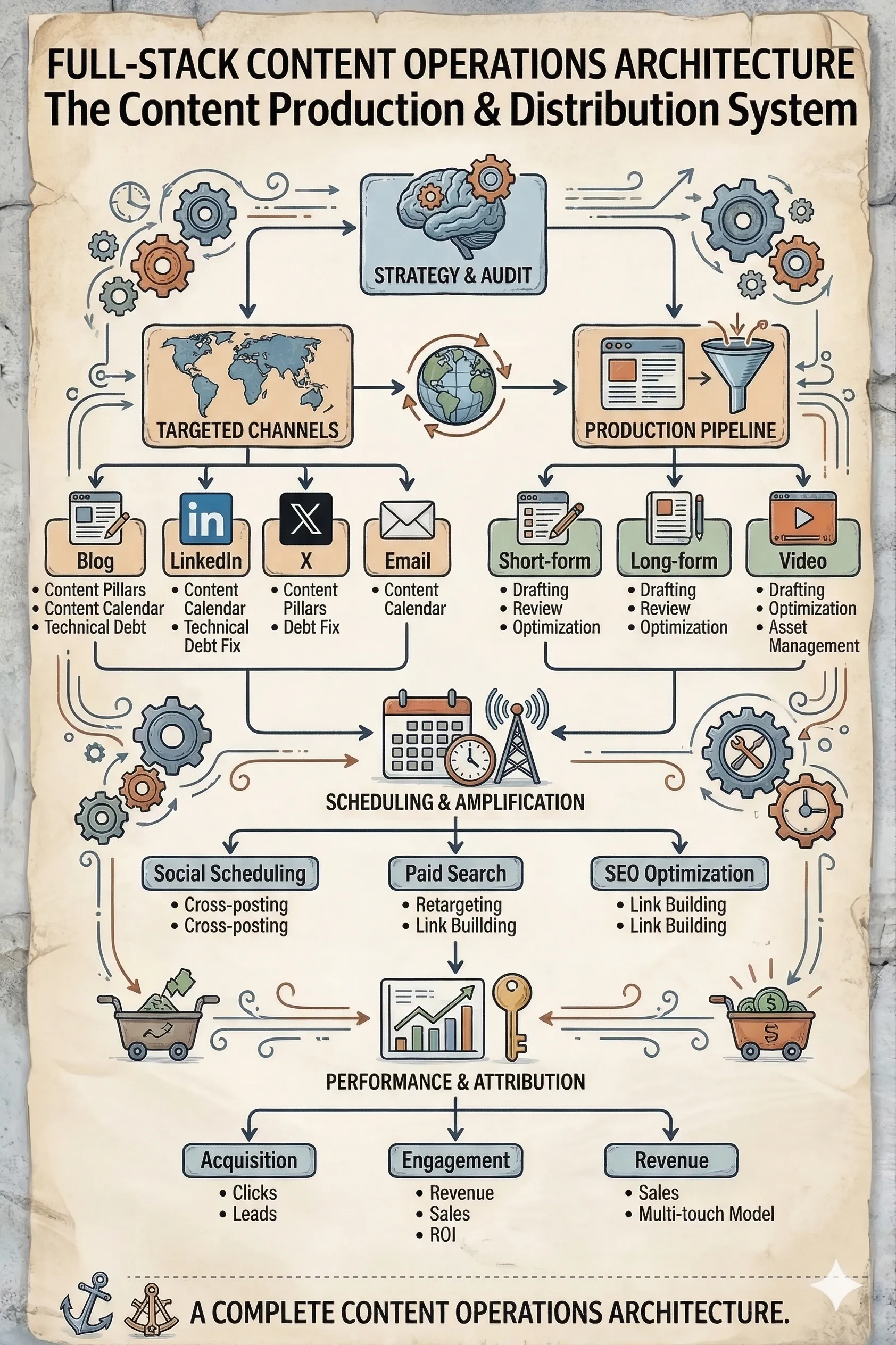
Content generation got cheap. Distribution didn't. Over the past year running Curify's own GTM we could draft a hundred pieces of content in a single afternoon, but moving the needle on actual user acquisition still required choosing the right channels, formatting per platform, and closing the loop with analytics. This post is the system we settled on after enough iteration to know which parts work — how we structure distribution across SEO, X, and Facebook Groups, what we automate, and what we deliberately keep manual.
Where 'just post everywhere' breaks
Three failures we kept hitting in the naive cross-post-everywhere approach:
1. Post once, ghost everywhere. The same prose copy-pasted to X, Facebook, and a blog gets ignored on at least two of the three. The format that wins on a 6-tweet thread reads as a rambling intro on a blog post. Each platform has its own pacing, length norm, and hook style — you can't share a single artifact across all of them and expect any of them to land.
2. Manual posting caps out at ~5 pieces a week. Even with AI drafting, the per-piece overhead (formatting, scheduling, captioning, hashtagging, image sizing, link tracking) costs about 30-45 minutes per platform. Three platforms × five pieces × 30 minutes = a full workday per week of pure shipping overhead, before quality drops.
3. No instrumented feedback = no learning. Posts go out, you check engagement six hours later, you forget which framing won and which flopped by Friday. Without per-post attribution wired into your analytics, you can't tell whether 'AI threads' won because of the topic, the headline, the time, or the format — so the next batch is still a guess.
1. Post once, ghost everywhere. The same prose copy-pasted to X, Facebook, and a blog gets ignored on at least two of the three. The format that wins on a 6-tweet thread reads as a rambling intro on a blog post. Each platform has its own pacing, length norm, and hook style — you can't share a single artifact across all of them and expect any of them to land.
2. Manual posting caps out at ~5 pieces a week. Even with AI drafting, the per-piece overhead (formatting, scheduling, captioning, hashtagging, image sizing, link tracking) costs about 30-45 minutes per platform. Three platforms × five pieces × 30 minutes = a full workday per week of pure shipping overhead, before quality drops.
3. No instrumented feedback = no learning. Posts go out, you check engagement six hours later, you forget which framing won and which flopped by Friday. Without per-post attribution wired into your analytics, you can't tell whether 'AI threads' won because of the topic, the headline, the time, or the format — so the next batch is still a guess.
The system: four stages, one loop
We stopped treating distribution as an event ('publish the post') and started treating it as a system with four named stages. The Mermaid chart below shows the loop. The text after the chart walks through each stage with what we automate and what we don't.
Four stages, one loop
Stage 1 — Format Adaptation
One idea, three platform-specific artifacts. Same underlying content; different shape per channel.
Website (SEO): 800-1,500 word structured page, scannable H2 hierarchy, anchor links to internal pages. Long-tail keyword targeted, indexed by Google.
X (Twitter): 6-12 tweet thread, first tweet is the strongest hook (no preamble), each subsequent tweet stands alone. Visuals on tweets 1, 3, and the last.
Facebook Groups: single 200-400 word post that opens with a question or observation, not a link. Comments-first format — the goal is replies, not click-throughs. The link, if any, goes in the first comment.
We use an LLM to draft all three from one source. The LLM gets the platform-specific format spec as system prompt; we review and tweak voice before scheduling. Drafting is automated; voice is human.
Website (SEO): 800-1,500 word structured page, scannable H2 hierarchy, anchor links to internal pages. Long-tail keyword targeted, indexed by Google.
X (Twitter): 6-12 tweet thread, first tweet is the strongest hook (no preamble), each subsequent tweet stands alone. Visuals on tweets 1, 3, and the last.
Facebook Groups: single 200-400 word post that opens with a question or observation, not a link. Comments-first format — the goal is replies, not click-throughs. The link, if any, goes in the first comment.
We use an LLM to draft all three from one source. The LLM gets the platform-specific format spec as system prompt; we review and tweak voice before scheduling. Drafting is automated; voice is human.
Stage 2 — Niche-First Distribution
The single biggest lift we got was switching from 'post everywhere' to 'post in specific communities with topical fit.' Examples from our own posting calendar:
- Movie-clip translation posts go to film-buff and language-learning groups, not the generic AI-tools groups.
- Bilingual subtitles content goes to ESL teacher communities, not the marketers' channel.
- AI strategy essays go to indie-hacker and SMB-founder communities, not the developer subs.
Same content, different targeting, 5-10× the engagement. The trade-off: niche communities have strict rules about self-promotion. You can't drop a link and run; you need to participate in the community for a few weeks before posting, and the post itself needs to be useful in the comment thread, not just a link-drop.
Scheduling is automated via hash-bucketed time slots (the same pattern Curify uses for its Twitter + Facebook autopost pipeline — see the curify_background autopost docs). Channel selection is not automated. Picking the right community for a piece of content is a human judgment call that's worth making per-piece, not per-channel.
- Movie-clip translation posts go to film-buff and language-learning groups, not the generic AI-tools groups.
- Bilingual subtitles content goes to ESL teacher communities, not the marketers' channel.
- AI strategy essays go to indie-hacker and SMB-founder communities, not the developer subs.
Same content, different targeting, 5-10× the engagement. The trade-off: niche communities have strict rules about self-promotion. You can't drop a link and run; you need to participate in the community for a few weeks before posting, and the post itself needs to be useful in the comment thread, not just a link-drop.
Scheduling is automated via hash-bucketed time slots (the same pattern Curify uses for its Twitter + Facebook autopost pipeline — see the curify_background autopost docs). Channel selection is not automated. Picking the right community for a piece of content is a human judgment call that's worth making per-piece, not per-channel.
Stage 3 — Performance Instrumentation
Without per-post attribution, every piece of content looks identical to the analytics dashboard. We attach a per-post UTM tag to every outbound link (X bio link, Facebook post comment link, blog internal links), then roll up by post ID in our admin dashboard.
What we instrument:
- Impressions per post: tells us reach by channel. Surfaces whether a channel is shadowbanned or losing reach over time.
- Click-through rate per post: tells us which framing won. The hook, not the topic.
- Bounce vs. action rate on the landed page: tells us whether the click was honest. High CTR + high bounce = clickbait hook; the second-best framing usually has better total conversion.
The dashboard rollup runs nightly. Friday afternoon we look at the week's top 3 and bottom 3 by conversion (not CTR alone) and write a one-paragraph note: what they had in common, what changed vs. last week. That paragraph is the input to Stage 4.
What we instrument:
- Impressions per post: tells us reach by channel. Surfaces whether a channel is shadowbanned or losing reach over time.
- Click-through rate per post: tells us which framing won. The hook, not the topic.
- Bounce vs. action rate on the landed page: tells us whether the click was honest. High CTR + high bounce = clickbait hook; the second-best framing usually has better total conversion.
The dashboard rollup runs nightly. Friday afternoon we look at the week's top 3 and bottom 3 by conversion (not CTR alone) and write a one-paragraph note: what they had in common, what changed vs. last week. That paragraph is the input to Stage 4.
Stage 4 — Feedback into the Next Batch
The Friday note from Stage 3 feeds three concrete decisions for next week:
- Format rotation: top-3 formats get more slots next week; bottom-3 get retired or rewritten. Over a quarter this prunes the format library down to what actually works.
- Topic prioritization: topics that hit on multiple channels go into the SEO long-tail page generation queue (SEO is the compounding asset — every winning piece becomes a permanent landing page).
- Channel rebalancing: channels with collapsing organic reach (X has been volatile, Facebook Groups stable) get less budget; channels with stable compounding (SEO, niche community + Substack) get more.
SEO is the long-game anchor. Social platforms are volatile — algorithm changes, account bans, audience drift. SEO pages, once ranked, keep compounding for months. We use the social channels to test which framings land, then commit the winners to long-form SEO pages that capture the search demand for the same topic.
- Format rotation: top-3 formats get more slots next week; bottom-3 get retired or rewritten. Over a quarter this prunes the format library down to what actually works.
- Topic prioritization: topics that hit on multiple channels go into the SEO long-tail page generation queue (SEO is the compounding asset — every winning piece becomes a permanent landing page).
- Channel rebalancing: channels with collapsing organic reach (X has been volatile, Facebook Groups stable) get less budget; channels with stable compounding (SEO, niche community + Substack) get more.
SEO is the long-game anchor. Social platforms are volatile — algorithm changes, account bans, audience drift. SEO pages, once ranked, keep compounding for months. We use the social channels to test which framings land, then commit the winners to long-form SEO pages that capture the search demand for the same topic.
What actually worked, what didn't
After running this loop for a few quarters, the observations that held up across at least three months of data:
Visual + structured content wins. Cards, templates, infographics — anything with a clear visual hierarchy — out-performed raw text by 2-3× on every channel we measured. The same topic with a comparison-table image versus a plain-text writeup typically got 5-8× the saves.
Bilingual content multiplies reach without multiplying effort. Posts that included both English and a second language (Chinese in our case) consistently got 30-50% higher engagement because the second-language audience had less competition. Same content, ~10% extra translation effort, meaningfully larger reach.
Repetition beats novelty. Reusing a winning format with new topics produced more compounding than constantly inventing new formats. The bottom-3 quartile of our posts were almost always one-off experiments; the top quartile was almost always a known format applied to a currently-hot topic.
Distribution is harder than generation. Generating 100 pieces of mediocre content with AI is easy. Getting any of them seen by the right audience, on the right channel, in the right format, with feedback wired in — that's where 80% of the actual work is. We learned this the hard way after a quarter of treating AI generation as the bottleneck and underinvesting in distribution.
Visual + structured content wins. Cards, templates, infographics — anything with a clear visual hierarchy — out-performed raw text by 2-3× on every channel we measured. The same topic with a comparison-table image versus a plain-text writeup typically got 5-8× the saves.
Bilingual content multiplies reach without multiplying effort. Posts that included both English and a second language (Chinese in our case) consistently got 30-50% higher engagement because the second-language audience had less competition. Same content, ~10% extra translation effort, meaningfully larger reach.
Repetition beats novelty. Reusing a winning format with new topics produced more compounding than constantly inventing new formats. The bottom-3 quartile of our posts were almost always one-off experiments; the top quartile was almost always a known format applied to a currently-hot topic.
Distribution is harder than generation. Generating 100 pieces of mediocre content with AI is easy. Getting any of them seen by the right audience, on the right channel, in the right format, with feedback wired in — that's where 80% of the actual work is. We learned this the hard way after a quarter of treating AI generation as the bottleneck and underinvesting in distribution.
🎯 Ready to ship the same pipeline at agency scale? Read the Growth Agencies playbook →
Where this leaves us
Distribution isn't a problem AI solved by getting cheaper. It's a problem AI changed — by making the volume side easy, it exposed how much the selection, formatting, and feedback parts had been doing the heavy lifting all along. The work shifted from 'can we make 50 posts this week?' to 'can we identify which 5 of those 50 deserve channel-specific formatting, niche-community targeting, and instrumented follow-through?'
If you're a creator or SMB running this yourself, the leverage is in the loop — Stage 4 feeding back into Stage 1. If you're running this across more than 5 brands or channels, the architecture above is the minimum viable shape; below that, you'll keep losing learning between batches.
If you're a creator or SMB running this yourself, the leverage is in the loop — Stage 4 feeding back into Stage 1. If you're running this across more than 5 brands or channels, the architecture above is the minimum viable shape; below that, you'll keep losing learning between batches.
Take the next step
Putting what you read into practice.
Browse related topics
More templates and prompts in these areas.
Related Articles
Content Automation
Content Automation
April 13, 2026•12 min read
The Curify AI Growth Engine: Transforming Content Creation for UGC Creators and Marketers
Read more
Content Automation
March 17, 2026•15 min read
Practical AI Platform: How Mid-Sized Tech Companies Win with AI
Read more
Content Automation
October 28, 2025•6 min read
Part 2: Agents vs Workflows – From Control to Intelligence
Read more