ML Engineer or AI Engineer? Two Career Paths, Two Value Structures
Many engineers debating their next move are framing it as a binary: should I work on search, ads, or recommendation systems (the classic ML engineer track), or move into LLM-based AI application development (the new AI engineer track)? This is not a traditional-versus-trendy choice. It is two fundamentally different value structures inside the same company.
Two Different Engines
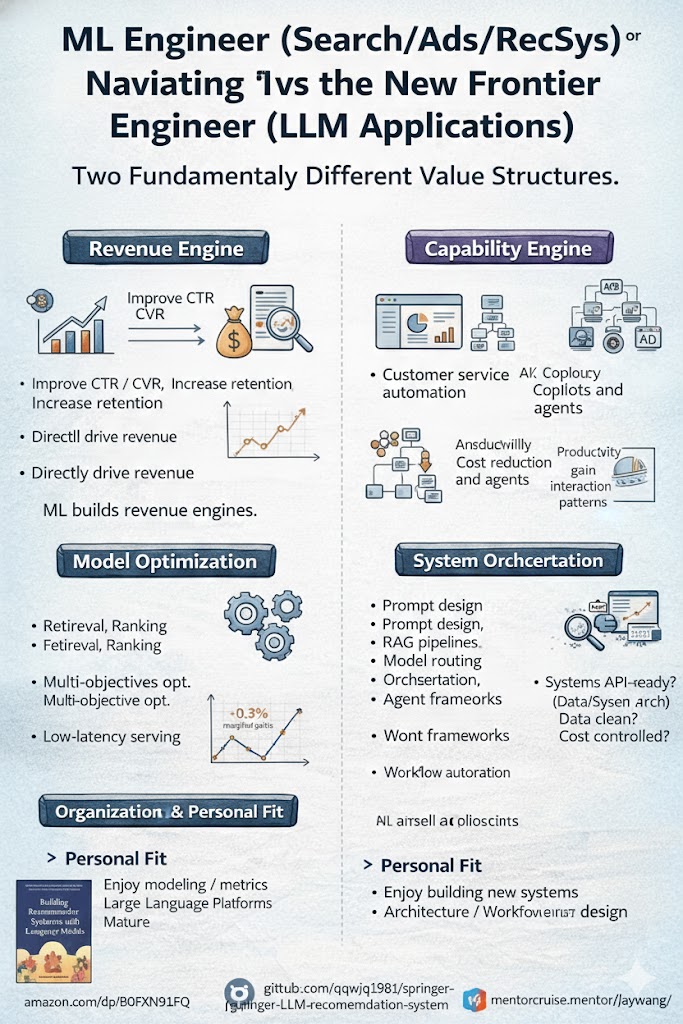
The simplest way to read this split: ML engineers (search / ads / recommendation) build the revenue engine. AI engineers (LLM applications) build the capability engine. Both are essential. They optimize for different things, depend on different inputs, and look for different signals of success. The next four sections compare them across business value, technical focus, organizational dependency, and personal fit so you can place yourself.
Comparing the Two Tracks
1. Business Value — Revenue Engine vs Capability Engine
ML (Search / Ads / Recommendation) is the company's growth engine. The day-to-day metrics are CTR, CVR, retention, and revenue lift. Impact is measurable and closed-loop: run an A/B test, see the delta, ship or roll back. At most internet companies, this team sits inside the core profit center.
AI (LLM Applications) is about organizational capability and efficiency: customer-service automation, content generation, copilots and agents, internal workflow redesign. The value is cost reduction, productivity gain, and new product interaction patterns. ROI is real but harder to measure than ad spend or recommendation lift — it shows up across the org rather than in one revenue line.
In short: ML builds revenue engines. AI builds capability engines.
2. Technical Focus — Model Optimization vs System Orchestration
Search / Ads / RecSys is algorithm-driven optimization. The core areas are retrieval, ranking, feature engineering, multi-objective optimization, and low-latency serving. The work is continuous tuning of a complex system for marginal gains — +0.3%, +0.5% on the metric that pays everyone's salary. SOTA from research papers is a benchmark, not an aspiration.
AI Engineering is system-integration-driven. The core areas are prompt design, RAG pipelines, model routing, agent frameworks, and workflow automation. The challenge usually is not the model itself — it is whether the surrounding systems are API-ready, whether the data is clean enough for retrieval, whether services can be orchestrated reliably, and whether inference cost stays under control.
3. Organizational Dependency
Recommendation systems can thrive once data infrastructure and experimentation platforms are mature. An ML engineer joining a company with a working A/B platform can drive impact in a quarter.
LLM applications are different. Their success depends heavily on the overall digital maturity of the organization: data quality (for retrieval grounding), system architecture (for API access), and cross-team integration (for workflow automation across departments). An AI engineer dropped into a company without these foundations will spend most of their time on plumbing rather than on AI.
This is why the same hire can succeed at one company and stall at another.
4. Personal Fit
You may prefer ML if you: enjoy modeling and metrics, care deeply about performance deltas, like long-term system optimization, and find satisfaction in moving a needle that prints money.
You may prefer AI engineering if you: enjoy building new systems from scratch, like automation and workflow design, think in terms of architecture and orchestration, and find satisfaction in eliminating manual steps rather than improving a metric by 0.3%.
Neither path is more "future-proof" than the other. The skills compound: an ML engineer who learns AI orchestration becomes a high-leverage product builder; an AI engineer who learns ranking and feature engineering becomes the rare person who can ship the next-generation recommendation system that uses LLMs as policy.
Tools & Resources
Learn about the best tools available...
How Curify Maps to Both Tracks
Curify's production stack hits both tracks. On the ML side, /nano-banana-pro-prompts runs ranking and retrieval across a 4,000+ prompt corpus tagged by 151 topics — classic recommendation pattern. On the AI engineering side, /tools/video-dubbing and the daily content-drop pipeline are orchestrated workflows: voice clone → translate → lip-sync → CDN upload, with auto-tagging via gpt-4o-mini at the end. Engineers contributing to Curify routinely cross between the two — the boundary is operational, not theoretical.
Pick the Engine, Not the Trend
If the only consideration were career mobility, AI engineering looks like the obvious answer right now. But the more useful framing is: which engine do you want to build? Revenue engines are the heart of how companies make money — the role is durable, the impact is measurable, the work is deeply technical, and the field is far from done. Capability engines are how companies reduce cost and unlock new product surfaces — the role is hotter at the moment, the wins compound across the org, and the integration work scales with company complexity. Neither choice is wrong. The wrong move is picking based on what's trendy rather than what kind of engine you actually want to spend your career building.
Take the next step
Putting what you read into practice.
Browse related topics
More templates and prompts in these areas.
Related Articles
DS & AI Engineering
From Probabilistic to Deterministic: Hard Truths About AI Engineering in Production
AI Is Reshaping the Data Workflow: From Assistant to Agent