The AI Content Factory: Why Marketing Agencies Need to Stop Buying Tools and Start Building Pipelines
Most marketing agency owners hit the same wall around the same client count. The 11th retainer signs, two more designers get hired, and the gross margin on the original ten accounts somehow drops. Hire faster than you sell and you starve; sell faster than you hire and quality collapses; price the work at "competitive" rates and the unit economics never close. This is the human scalability trap, and for agencies running low-ticket social posting and seasonal poster work, it is structural — not a planning problem. Buying ChatGPT, Midjourney, and a SaaS layout tool does not break it. It just moves the bottleneck from "designer hours" to "designer-tuning-prompts hours." The real exit is a different architecture entirely: stop trying to make individual employees faster at the old workflow, and start running the agency's content production like a high-concurrency recommendation system.
Why Low-Ticket Social Packages Bleed Margin
The Agency Management Institute's 55:25:20 rule is the benchmark every healthy agency points at: 55% of adjusted gross income to people, 25% to overhead, 20% retained as net profit. That math works at a revenue-per-employee around $135k-$257k. Now look at the standard SMB social media retainer — $500 to $1,500 per month for two to three platforms and 8 to 12 posts.
Run the math honestly. A $1,000 retainer works out to roughly 40 billable hours, and those hours have to cover strategy, design, copy, scheduling, client back-and-forth, revisions, and any QA. There is no realistic scenario in which a junior designer cranking through three retainers a week keeps the margin above water. Most agencies cope one of two ways:
- Loss-leader pricing. Take the small accounts at a loss, hope to upsell premium services later. In practice this anchors the brand at the loss-leader price and the upsell almost never happens.
- Quiet underdelivery. Hit the contracted post count but skip the strategy, the QA, and the cross-platform polish.
Both paths lock the agency into low prices and grind employees into delivery work that crowds out new business development. Single-client concentration above 40% becomes a load-bearing wall, and the owner ends up running an inflated job rather than a leveraged business.
Borrow the Four-Stage Architecture from Recommendation Systems
1. Retrieval — Intent Replaces the Creative Brief
Traditional flow: account manager runs a 60-minute discovery call with the client, types up a creative brief, hands it to a strategist who hands it to a designer.
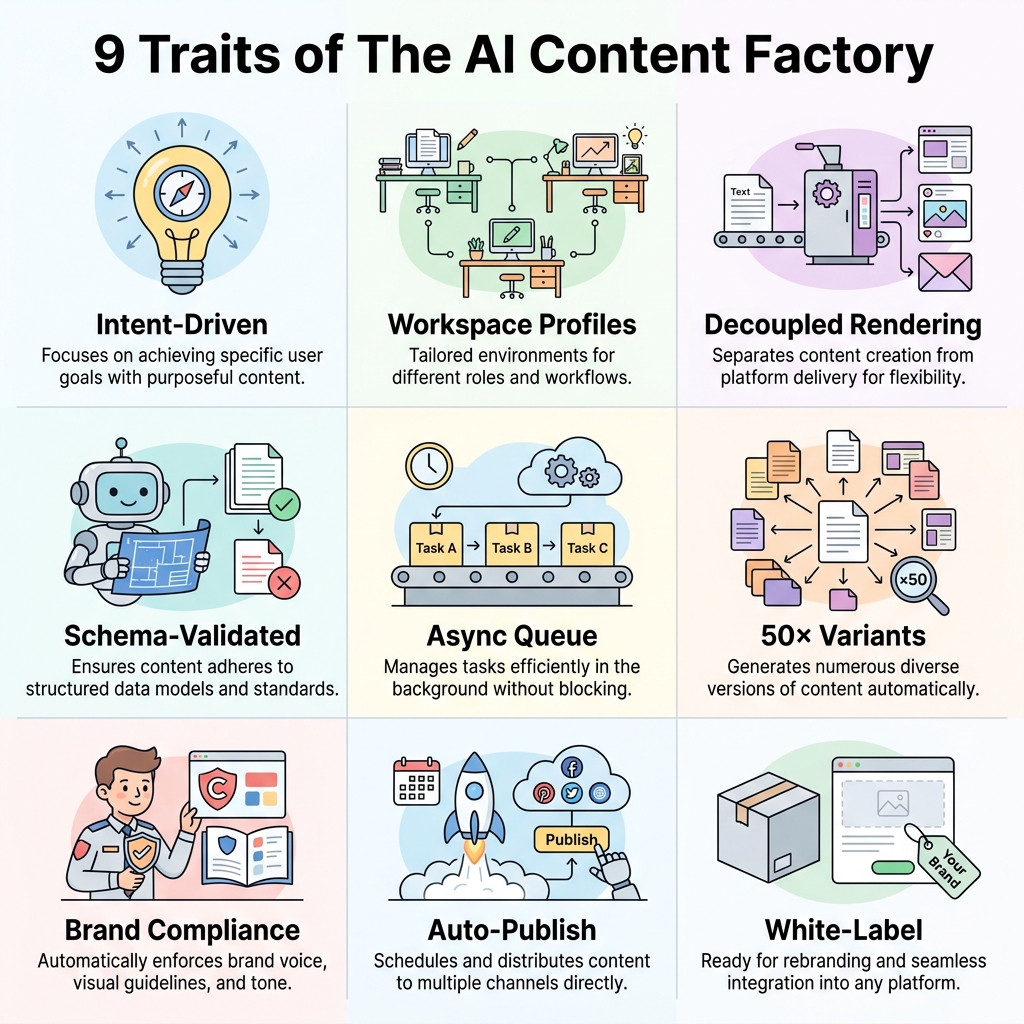
Pipeline flow: every client has a structured Workspace Profile — brand colors as hex codes, voice descriptors (authoritative / playful / technical), top three offerings, target audience persona spec, geographic context. When a single campaign topic comes in ("Black Friday flash sale"), the retrieval layer looks up the profile, pulls the matching template structure from a curated template library, and emits a structured intent object. No discovery call. No misremembered brand guideline. The intent layer is also where you encode hierarchies: "brand compliance always wins over creative latitude," "logo must remain clear and unobstructed," "platform CTA conventions take precedence over copy preferences." This is what AI engineers call intent engineering — encoding business priorities into the system itself instead of pasting them into prompt strings.
2. Filtering — Decoupled Rendering Kills the Gibberish-Text Problem
The reason early "auto-poster" tools embarrassed themselves was the same reason early diffusion models embarrassed themselves at typography: a single end-to-end image model trying to render readable English on a textured background hallucinates characters like a drunk neon sign. The production fix is decoupled rendering — keep the image model in its lane (generate the background art, the textured layer, the illustrative motif), then composite typography on top via a deterministic renderer that knows fonts, kerning, and bounding boxes.
Combined with multimodal verification (a small vision-language model checks every render for compliance — logo present, no broken type, brand hex within tolerance) and an RLHF-tuned aesthetic reward, the filter stage drops the human-correction loop entirely. Open-source baselines on poster generation now hit ~0.77 OCR F1 on the rendered output — meaning the system reads its own output before serving it. Designers stop being copy-editors for the model.
3. Scoring — One Intent, Fifty Variants, Pixel-Perfect Layout
With the background art validated, the scoring stage assembles the final asset against the spec: vector logos placed at exact coordinates, CTA buttons sized to platform conventions, bleed margins set for print, safe zones honored for vertical video crops. The technology is unremarkable once you name it — a headless HTML/CSS/SVG renderer (a Puppeteer or Playwright cluster) driven by an async job queue (Celery + Redis is the common stack).
What is interesting is the architectural consequence: one campaign intent fans out into 50 platform-shaped variants in parallel without anyone opening Photoshop. This is where the per-account cost actually moves. A $1,000 retainer that previously consumed 40 designer-hours now consumes a few cents of compute. The agency's incremental cost to add the 11th client is a config row, not a hire.
4. Serving — Auto-Publish, Not Copy-Paste
The last stage is where most "AI for agencies" content stops short — generation without distribution. The pipeline pushes finished assets and per-platform copy directly into a publishing queue: Meta Graph API for Instagram and Facebook, X API for Twitter, Buffer or n8n flows for the long tail. No screenshots passed in Slack, no "can you add the alt text on TikTok," no Friday evening rush to copy-paste captions across five tabs.
Once serving is automated, the agency's operating model changes shape. Account managers spend their time on strategy and account growth; the production system handles execution. The headcount line on the P&L decouples from the client count line.
Why "Just Use Better Prompts" Does Not Get You Here
Most agencies that try to automate fail at one of three places:
- Tool-frame vs system-frame. They treat AI as a faster employee instead of redesigning the workflow. Designers end up "writing prompts" instead of "doing design." The bottleneck moves but does not shrink.
- Goal drift. Without an intent layer enforcing brand compliance, the agent optimizes whatever is easiest to measure (click rate, generation speed) and quietly sacrifices what is not measured (brand consistency, customer trust). A few weeks in, the system is shipping clickbait at scale.
- The escalation trap. Whenever the agent hallucinates a malformed JSON, illegible text, or a logo-covering composition, the workflow stalls and a human has to clean up. Throughput then caps at the human's review bandwidth — the system technically "automates" but practically just queues work for the same designer who used to do it.
Gartner projects that more than 40% of enterprise agentic AI projects get cancelled by end of 2027 — not because the models got worse, but because the surrounding architecture was never built. The fix is not stronger prompts. It is schema-validated retrieval, deterministic rendering, automated evaluation, and observability — the same engineering hygiene that turned recommendation systems from research demos into infrastructure.
Tools & Resources
Learn about the best tools available...
Where This Plays Out at Curify
The four-stage pattern above is not theoretical. The Curify Studio stack ships it end-to-end, and an agency can wear it as a white-label backend:
- Retrieval. Workspace Profiles capture each client's brand specs once and feed every downstream stage. Two curated template libraries —
template-marketingfor campaign formats andtemplate-mbtifor audience-segmented variations — provide structure without a brief.
- Filtering. 172 parameterized prompt templates with typed inputs across /nano-template keep every render schema-validated. The model never sees a free-form prompt; the agency never sees a parse error.
- Scoring. A headless rendering layer fans one campaign intent into 50 platform-sized variants — Instagram square, Story vertical, LinkedIn landscape, X portrait, all in parallel.
- Serving. Auto-publishing to Twitter and Facebook on hash-bucketed slots; see
/tools/video-dubbingfor the equivalent dub-and-distribute pipeline on video.
For an agency, the leverage is in the white-label layer. The client logs into an agency-branded dashboard; the agency runs Curify's pipeline underneath; the headcount line on the P&L stops growing with client count.
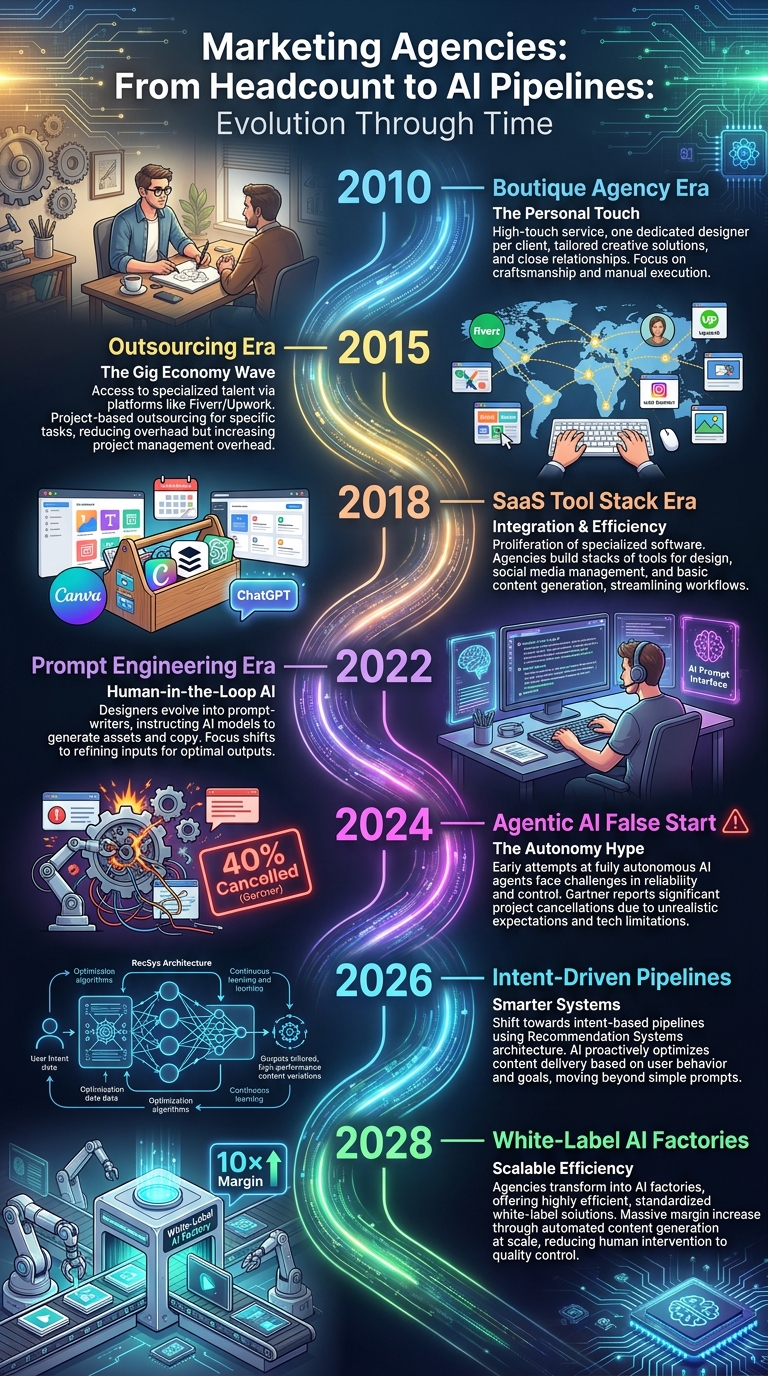
The 10× Margin Leap Is in the Architecture, Not the Prompts
The agencies that scale through the next two years will not be the ones that hired the smartest prompt engineers. They will be the ones that stopped thinking about AI as a faster tool for the same workflow, and started thinking about content production as an engineering problem with a known shape — retrieve, filter, score, serve.
For an agency owner staring at the next 10 retainers and quietly dreading the next 10 hires, the question to ask is not "which AI tool should I buy?" The question is: "what would my P&L look like if my incremental cost per client was a config row instead of a headcount?"
That gap — between the prompt-engineering crutch and the intent-engineered pipeline — is where the next decade of agency margins gets built or lost.
Take the next step
Putting what you read into practice.
Browse related topics
More templates and prompts in these areas.
Related Articles
Content Automation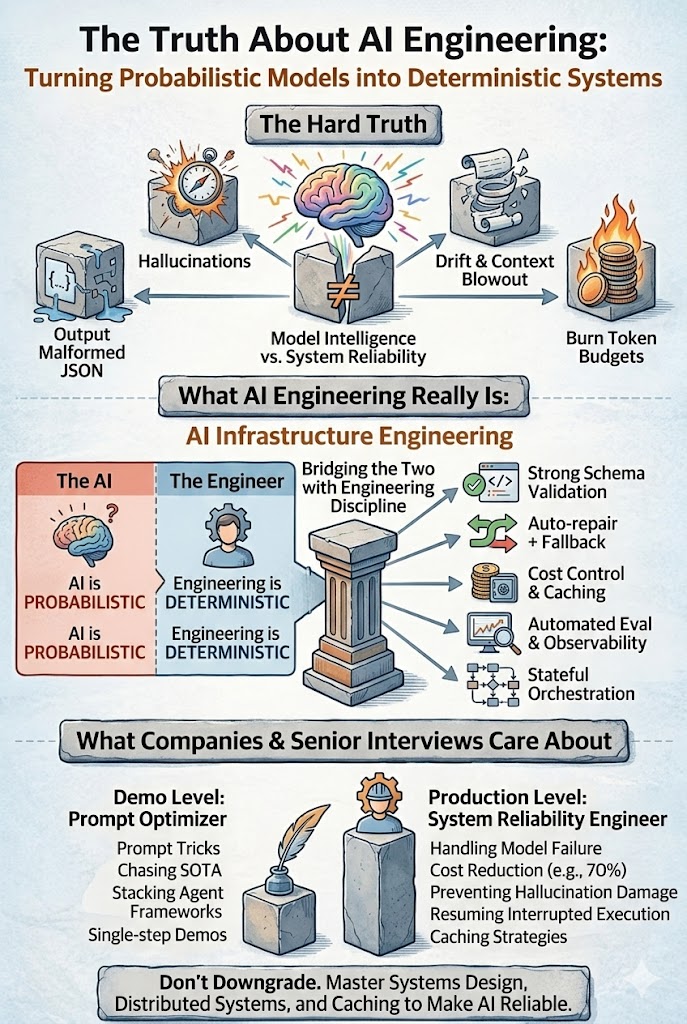
From Probabilistic to Deterministic: Hard Truths About AI Engineering in Production
AI Is Reshaping the Data Workflow: From Assistant to Agent