From Probabilistic to Deterministic: Hard Truths About AI Engineering in Production
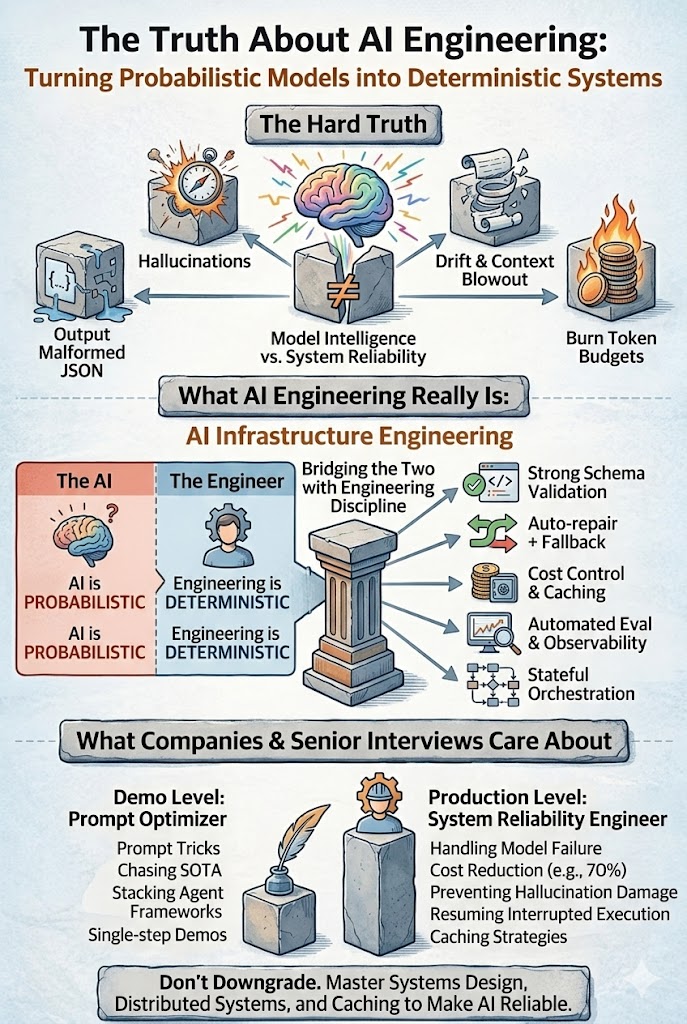
Most SMB leaders who tried generative AI in 2024-2025 walked away with the same impression: it feels like a slot machine. The demo was magical. The production rollout was a coin flip — broken JSON one run, hallucinated invoice numbers the next, a $4,000 monthly bill on the third. The conclusion they reached was reasonable but wrong: "AI is not ready for our business yet." The actual conclusion: the model worked. The system around it did not. AI Engineering — the discipline of turning probabilistic models into deterministic systems — is what closes that gap, and it is what most SMB pilots never had.
Why AI Pilots Feel Like a Slot Machine
Large language models are probability machines by construction. The same input prompt, run twice, can produce two different outputs. That is not a bug — it is what makes the model creative and useful. But it is also what makes naïve integrations unsuitable for any business process that needs to repeat reliably.
The five failure modes that show up in every SMB AI pilot are predictable:
- Malformed JSON output. The model returns a structured response that looks right but breaks the downstream parser one in twenty calls. The pipeline silently drops orders, miscounts inventory, or skips approval steps.
- Hallucination. The model invents a customer name, a product SKU, an order date, or a price that does not exist. In a chatbot this is annoying. In an automated invoicing or compliance step this is a business risk.
- Reasoning drift. Long-running agents start the task with the correct goal and end somewhere unrelated — the context window filled with irrelevant intermediate output and the original objective was lost.
- Context blow-up. A simple query that should take 2,000 tokens balloons to 80,000 because every previous turn is being re-sent. Latency goes from 3 seconds to 45.
- Runaway cost. The pilot worked in October at $200. In December the same workflow cost $4,000 because traffic grew 20× and nobody put a budget guard in place.
None of these are fixed by writing a better prompt. They are fixed by engineering around the model — the same way a senior backend engineer would handle any unreliable third-party API.
The Four Engineering Layers That Make AI Deterministic
1. Schema Validation, Auto-Repair, and Fallback
First line of defense. Every model output that crosses a system boundary gets validated against a schema before anything downstream uses it. When validation fails — and it will, regularly — the system does not throw. It runs an auto-repair pass (smaller model fixes the malformed JSON, retries with a stricter prompt, or extracts the valid subset) and falls back to a deterministic default if repair fails.
For an SMB owner this is the difference between a chatbot that quietly skips a customer message once a day and one that surfaces every parse failure as a human-review queue. The probability of model failure does not change. The probability of business failure goes from ~5% per call to <0.1%.
2. Semantic Caching and Cost Control
Most AI workloads have a huge amount of redundant work. Two customers ask "what is your return policy" in slightly different words; today's naïve implementation makes two model calls. A semantic cache (vector similarity over recent prompts + answer reuse when similarity is above a threshold) collapses that to one call, often cutting token spend by 50-80% without changing the user experience.
Pair this with hard per-tenant token budgets, per-feature rate limits, and a smaller-model routing rule for low-stakes queries, and the runaway cost problem stops happening. "AI was too expensive" is almost always a missing cost-control layer, not an expensive model.
3. Stateful Orchestration and Checkpoint Recovery
Multi-step workflows — generate a draft → review → format → publish — are where reasoning drift and context blow-up actually bite. The fix is to treat the workflow like a state machine: each step has explicit inputs, explicit outputs, and a checkpoint. If step 3 fails after step 2 succeeded, the system resumes from the step-2 output instead of restarting the whole agent and burning every token again.
This is how a 30-minute video translation pipeline survives a transient API timeout: the segments already processed stay processed, the failed segment retries with backoff, and the user sees "resumed" instead of "started over."
4. Automated Evaluation and Observability
The last layer is the one most pilots never reach: knowing whether the system is getting better or worse over time. Automated evaluation pipelines score every model output against a golden set on the dimensions that matter — factual accuracy, format compliance, business policy adherence. Observability captures latency, token cost per request, per-tenant failure rate, and the actual prompts that broke validation.
Without this, every model change is a guess. With it, a leader can answer: "Did the change we shipped last week reduce hallucinations or did it just feel faster?" That question is the difference between an AI program that compounds and one that stalls.
What Production AI Interviews (and Production Failures) Actually Test
There is a useful tell for whether a candidate or vendor has done production AI work. The questions a serious team asks are not about prompt techniques. They are:
- The model returns malformed JSON three times in a row — what happens to the user?
- A hallucinated customer name caused a wrong invoice — how did the system catch it before sending?
- The token bill went 20× — what was the missing layer, and how would you cap it?
- How do you build a semantic cache that does not return stale answers when policy changes?
- A long-running agent failed at step 7 of 12 — does it restart from zero, or resume from step 6?
- The agent's output "feels better" after a prompt change — how do you measure whether it actually improved?
Answers that start with "I would tune the prompt" are the give-away: this person has built demos, not systems. Answers that start with schema validation, fallback hierarchies, cost guards, checkpointing, and evaluation harnesses are what production AI looks like.
For SMB leaders evaluating a vendor or a hire: ask these six questions directly. The answers tell you whether you are buying a slot machine or a system.
Tools & Resources
Learn about the best tools available...
How This Plays Out at Curify
These layers are not abstract. The Curify content stack runs every one of them in production:
- Template engine as schema validator. The /nano-template library is 172 parameterized templates where every prompt has typed inputs and a validated output structure. A B2B partner sending us a brand-aligned template gets the same JSON shape back every time — the model never sees a free-form prompt, the user never sees a parse error.
- Multi-stage pipeline with checkpoints. /tools/video-dubbing is voice clone → transcribe → translate → lip-sync → CDN upload. Each stage checkpoints; a failure at lip-sync does not re-clone the voice.
- Semantic search backed by an evaluation loop. The /nano-banana-pro-prompts corpus serves 4,000+ prompts behind a tag + topic + embedding-similarity search; every query is scored against a ground-truth set and the search-quality doc tracks lift week over week.
- Cost guards by design. Per-feature token budgets, smaller-model routing for low-stakes queries, and a semantic cache layer keep monthly inference cost flat as traffic grows.
The pattern is the same one any SMB AI deployment needs. The template engine is just one way to enforce it — but the underlying discipline (schema-first, checkpointed, evaluated, observed) is universal.
If Your AI Pilot Felt Like a Slot Machine, You Did Not Have an AI Engineer
Generative AI is genuinely a step-change in what software can do. Most SMB pilots that failed in 2024-2025 did not fail because the model was bad. They failed because no one put the deterministic system around it. The work of turning probabilistic outputs into reliable business processes — schema validation, fallback hierarchies, semantic caching, cost control, stateful orchestration, automated evaluation, observability — is what AI Engineering actually is.
If you are an SMB owner who walked away from AI thinking "this is not for us yet," the more accurate read is: "this is not for us without the engineering layer." That engineering layer is investable, repeatable, and increasingly well-understood. The companies that figure it out in the next 12 months will not be the ones with the best prompts. They will be the ones with the best containment systems around the model.
AI gets smarter every quarter. The leaders who can make it reliable in their business become the scarce asset.
Take the next step
Putting what you read into practice.
Browse related topics
More templates and prompts in these areas.
Related Articles
DS & AI Engineering
The AI Content Factory: Why Marketing Agencies Need to Stop Buying Tools and Start Building Pipelines
AI Is Reshaping the Data Workflow: From Assistant to Agent