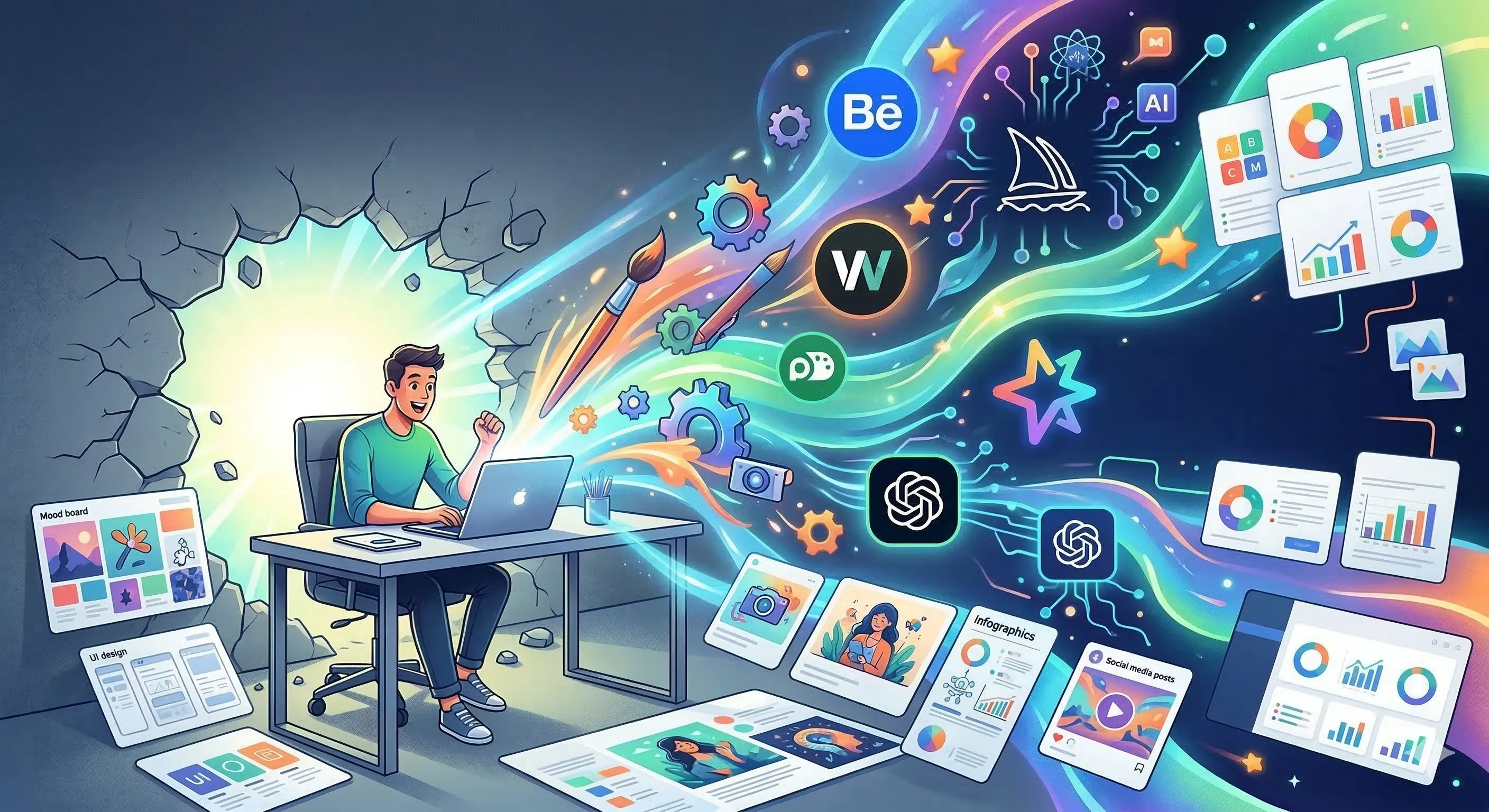
Midjourney vs DALL-E 3 vs Nano Banana vs Stable Diffusion (2026)

"Midjourney vs DALL-E 3 vs Stable Diffusion" is still the most-searched AI image comparison in 2026 — but the cast list has changed. Midjourney is now on v7. DALL-E 3 has been quietly succeeded by GPT Image 2 inside ChatGPT. The bigger 2026 story is Google's Nano Banana Pro (Gemini 3 Pro Image) muscling into the top tier with real-time search grounding and a built-in reasoning step. Stable Diffusion 3.5 Large is the new open-source 8-billion-parameter base. Pure photorealism has been commoditized across the top tier; what separates these models now is *what each one makes easy*. This is the 2026 verdict for creators choosing one — or all three — for their workflow.
Understanding AI Image Generation Models
AI image generation in 2026 splits into two camps. Diffusion models (Stable Diffusion, Midjourney v7, Black Forest Labs' FLUX.2) start from random noise and gradually denoise into your image — they're the photorealism and aesthetic specialists. Autoregressive transformers (Google's Nano Banana Pro, Luma Uni-1, OpenAI's GPT Image 2) build images token-by-token like a language model writes sentences — they're the spatial-reasoning and grounded-logic specialists. Why does this matter for creators? Diffusion models can dazzle with light and texture but sometimes fumble "the cat is on the left of the dog, not the right." Autoregressive models nail those spatial relationships natively but pay for it in slightly slower generation. The three models below sit at different points on this spectrum.
The Big Three: A 2026 Overview
Three models, three philosophies. **Midjourney v7** prioritizes editorial aesthetic. **Nano Banana Pro** (Google's flagship image model under the Gemini 3 hood) prioritizes accurate reasoning with real-world grounding. **Stable Diffusion 3.5** prioritizes control and ownership. The architectural differences below shape every downstream tradeoff — speed, cost, prompt accuracy, and how much each model lets you customize.
Nano Banana Pro: The Reasoning Powerhouse
Nano Banana Pro is Google's commercial-grade image generation model, served under the Gemini 3 Pro Image API. It uses an autoregressive transformer architecture — building images token-by-token through a "thinking process" that decomposes complex prompts *before* rendering. Two endpoints in the lineup: **Nano Banana Pro** (the full-reasoning flagship — slower, sharper, supports 4K upscaling) and **Nano Banana 2** (the Flash-tier fast variant for high-volume work). The headline differentiator is **real-world grounding**: Nano Banana can query Google Search in real time to ground generated images in current factual reality. Ask for a historically accurate diagram, a multilingual marketing graphic, or a brand mockup with a current logo — Nano Banana looks it up before drawing. It also supports **multi-turn conversational editing** ("keep the layout, change only the lighting to golden hour") across up to 14 reference images per session. Access: Google AI Studio for casual creators, the Gemini API for programmatic use, or Vertex AI for enterprise. Every output carries an invisible **SynthID** watermark for provenance tracking — useful for commercial pipelines. **Strength**: factually grounded outputs, conversational editing, and Workspace integration. **Weakness**: less editorial *wow factor* than Midjourney; some artistic style requests come back understated. Search grounding adds a few seconds to generation time.
Midjourney v7: The Artistic Specialist
Midjourney released v7 in April 2025 and it remains the default into 2026. v7 keeps Midjourney's signature: cinematic lighting, editorial color grading, and what users call "the wow factor" — the model takes creative liberties to enhance shadow dynamics and texture even when you didn't ask. That's a feature for concept art and a bug for clients who want literal interpretations. Midjourney still has no public developer API; access remains via Discord and the official web app. v7 introduced **`--style raw`** for unvarnished realism instead of the default art-direction polish, robust personalization profiles that learn your taste over time, and an expanded chaos parameter family for controlled variation. Aspect-ratio support spans portrait, landscape, and ultra-wide formats without degrading composition. **Strength**: best-in-class aesthetic appeal, color, and lighting — the model that most often makes you say "how did it know to do *that*?" **Weakness**: lower literal prompt fidelity than autoregressive models; no API for automation; character identity drifts across generations unless you use external consistency tools.
Stable Diffusion 3.5: The Open-Source Champion
Stable Diffusion 3.5 Large (Stability AI's 2026 flagship) is an 8-billion-parameter model on the new **MMDiT-X** architecture, runnable on consumer GPUs with 16GB+ VRAM. The distilled **3.5 Large Turbo** variant produces 1-megapixel outputs in just four inference steps — fast enough for real-time iteration on a single RTX 4090. The moat hasn't changed: **fully open weights**. Full data sovereignty (your prompts never leave your machine), zero per-image cost after hardware, and a thriving ecosystem of community **LoRAs** (small fine-tuning files) that let you specialize the model for a single character, a brand style, or a niche aesthetic. Native **Depth and Canny ControlNets** let you constrain compositions from a sketch, pose reference, or depth map — useful when you need a specific pose or layout, not just "a person standing." **Strength**: ownership, customization, no recurring fees, the deepest community ecosystem. **Weakness**: requires a hardware investment plus a learning curve; out-of-the-box quality trails the closed-source leaders until you tune it with a domain-specific LoRA.
Head-to-Head Comparison
Let's dive deep into how these models stack up across key performance metrics that matter for different use cases. We'll examine technical specifications, real-world performance, and practical considerations to help you make the best choice for your specific requirements.
| Feature | DALL-E 3 | Midjourney | Stable Diffusion |
|---|---|---|---|
| Resolution | 1024×1024 | Variable (up to 2048×2048) | Customizable (512-2048+) |
| Speed | 10-30s | 30-60s | 2-60s (GPU dependent) |
| Cost per Image | $0.04 | $0.33-2.00 | Free (hardware/cloud cost) |
| Learning Curve | Easy | Medium | Hard |
Image Quality & Realism
Midjourney v7 still wins raw aesthetic appeal — the images look like a magazine editorial chose them. Color grading and lighting decisions feel curated, not generated.
Nano Banana Pro wins prompt accuracy and grounded reasoning. Describe a scene with five elements in specific spatial relationships and it holds them all without conceptual bleeding. Ask for a historically accurate diagram and the Google Search grounding gives you correct labels and proportions instead of plausible-looking nonsense.
Stable Diffusion 3.5 has variable out-of-the-box quality — solid but not magical. With a tuned LoRA for your specific subject or style, it can match or beat the closed-source options for any niche application. The ceiling is uncapped if you're willing to do the tuning work.
Generation Speed & Efficiency
Nano Banana Pro generates in 8-20 seconds for the full reasoning Pro tier, faster for Nano Banana 2 Flash. Conversational editing is near-instant once an initial image exists since the model is reusing context from the previous turn.
Midjourney v7 generates a 4-image grid in 30-60 seconds via Discord or the web app. Fast mode (Standard plan and above) trims that to ~20 seconds per batch.
Stable Diffusion 3.5 generates a 1MP image in 4 inference steps with the Turbo variant — call it 2-4 seconds on an RTX 4090, longer on smaller cards. The full Large model trades that speed for higher detail (20-40 steps, 10-15 seconds on the same hardware).
Pricing & Accessibility
Nano Banana Pro is accessed via Google AI Studio (free tier for casual creators, generous monthly allowance) or the Gemini API for programmatic use (metered per image, competitive with other top-tier models). Enterprise access via Vertex AI.
Midjourney uses subscriptions: Basic ($10/mo, ~200 images), Standard ($30/mo), Pro ($60/mo), and Mega ($120/mo, effectively unmetered). No public API, so subscription is the only access path for most users.
Stable Diffusion 3.5 is free to download and run. The real cost is a one-time hardware investment (a 16GB+ VRAM GPU is $700-1,500 new) or cloud compute by the hour (Runpod, fal.ai, or Replicate at $0.50-2/hour). After that, generation itself is free.
Best Use Cases for Each Model
Nano Banana Pro: Factual infographics, product mockups with real brand logos, multilingual marketing graphics, historically accurate visuals, and anything where conversational iteration ("now change the lighting to evening") matters more than artistic surprise. Best for non-technical users who want plain-English control.
Midjourney v7: Concept art, book covers, brand identity exploration, editorial illustration — anything where aesthetic *wow* matters more than literal accuracy. The first-choice tool when you want to be surprised in a good way.
Stable Diffusion 3.5: Custom character pipelines (with LoRA training), production-grade asset factories, privacy-sensitive work, and any workflow where you'll generate the same kind of image hundreds of times and need consistency at zero marginal cost.
Marketing Materials
Product mockups, ad creatives, social media graphics
Creative Projects
Concept art, book covers, illustrations
Technical Applications
Batch processing, custom workflows, API integration
Tools & Integration Options
Nano Banana Pro: Google AI Studio (web), Gemini API with Python/JS SDKs, Vertex AI for enterprise, plus deep integration in Google Workspace (Slides, Docs) and most third-party AI workflow platforms.
Midjourney v7: Discord bot (still the main interface), the official web app (better for batch and gallery management), no public API yet.
Stable Diffusion 3.5: AUTOMATIC1111 web UI, ComfyUI (node-based workflow editor), Forge, InvokeAI, plus cloud frontends like Replicate, fal.ai, and Stability's own API for those who want managed inference without buying hardware.
Integration Difficulty
How Curify Enhances Your Image Generation Workflow
Curify doesn't replace these models — it sits *between* them and your finished content. Our nano-template library supplies battle-tested prompt patterns for the most common creator outputs (character cards, infographics, lifestyle scenes, product mockups, learning visuals) that work across all three engines. The /nano-banana-pro-prompts directory specifically curates prompt patterns tuned for Google's Nano Banana Pro, with one-click variants for character, product, and educational use cases. Browse /nano-template for the broader catalog and the /topics/character hub for character-specific templates that ship pre-tagged with the right prompt shape. For workflows that go beyond static images — adding bilingual audio, lip-synced narration, or social-ready video formats — Curify's pipeline picks up where the image models end.
Unified Workflow
Single platform for all three models with consistent interface
Prompt Optimization
AI-powered prompt enhancement for better results across models
Asset Management
Organize and categorize generated images with smart tagging
Batch Processing
Generate multiple variations simultaneously for faster iteration
Future Trends in AI Image Generation
Technical Advancements
- Higher resolution outputs (4K+)
- Real-time generation capabilities
- Improved prompt understanding
- Better style consistency
Market Evolution
- Decreasing costs per generation
- More specialized models
- Enterprise-grade solutions
- Integration with creative workflows
Frequently Asked Questions
Which model is best for beginners?
Nano Banana Pro (via Google AI Studio) and GPT Image 2 (the DALL-E 3 successor inside ChatGPT) are the most beginner-friendly — type what you want in plain English, get an image, iterate conversationally. Midjourney v7 has a Discord/web learning curve. Stable Diffusion 3.5 needs technical setup unless you use a managed cloud frontend like fal.ai or Replicate.
Can I use these models commercially?
All three support commercial use. Nano Banana Pro and Midjourney v7 grant commercial licenses with their paid plans (Google embeds an invisible SynthID watermark in Nano Banana outputs for provenance). Stable Diffusion 3.5 is open-source under a permissive license, but check individual community LoRA licenses — some are non-commercial.
How do I choose between quality and speed?
For quick iteration and concept work, Nano Banana 2 (Flash tier) or Stable Diffusion 3.5 Turbo (2-4 second generation on a strong GPU). For final production work where aesthetic matters most, Midjourney v7 or Nano Banana Pro at the full reasoning tier. For consistent series with a specific character or brand style, Stable Diffusion 3.5 Large with a tuned LoRA wins on per-image consistency.
What hardware do I need for Stable Diffusion?
Minimum: GPU with 12GB VRAM for distilled models like Stable Diffusion 3.5 Turbo. Recommended: 16-24GB VRAM for the full 3.5 Large model and faster generation. Cloud rentals (Runpod, fal.ai, Replicate) are $0.50-2/hour if you'd rather not buy hardware up front — useful for trying SD before committing to a GPU purchase.
Making the Right Choice for Your Needs
The 2026 verdict: there's no single winner — and there shouldn't be. Midjourney v7 wins when aesthetic is everything. Nano Banana Pro wins when you need grounded reasoning, factual accuracy, or conversational iteration. Stable Diffusion 3.5 wins when you need control, customization, or full data ownership. Most working creators use at least two — ideation in one engine, final production in another.
One bigger shift to know: in 2026, pure photorealism has been commoditized across the top tier. The premium now sits on spatial reasoning and editorial control — being able to say "change only the lighting, keep everything else identical" and have the model actually do it. Other 2026 entrants worth watching: FLUX.2 (Black Forest Labs, leads photorealism API), Luma Uni-1 (autoregressive, leads spatial-reasoning benchmarks), and Reve Image v1.5 "Halfmoon" (currently topping aesthetic leaderboards).
And if you've been searching for DALL-E 3: it has been quietly succeeded by GPT Image 2 inside ChatGPT. If you've been using DALL-E 3, you're already using its successor — same chat interface, more capable autoregressive backbone under the hood.
Take the next step
Putting what you read into practice.
Browse related topics
More templates and prompts in these areas.
Related Articles
Creator Tools
Best AI Tools for Video Content Creators in 2026: Descript vs ElevenLabs vs Runway
How to Write Prompts for Nano Banana: 10 Tips for Creators