One-Person Companies Are Crushing It. Your 100-Person Team Is a Liability.
Solo operators using Claude, Cursor, and Copilot are genuinely out-shipping whole engineering and marketing departments. The structural decay of 50–200-person companies — long tolerated as "big company disease" — has crossed into existential-risk territory for SMB leadership in 2026. Below: the five liabilities to spot in your org chart, the three structural moves that fix them, and what a 90-day pilot looks like for an SMB leader who doesn't want to be the next cautionary tale.
The Structural Decay That Used to Be Tolerable
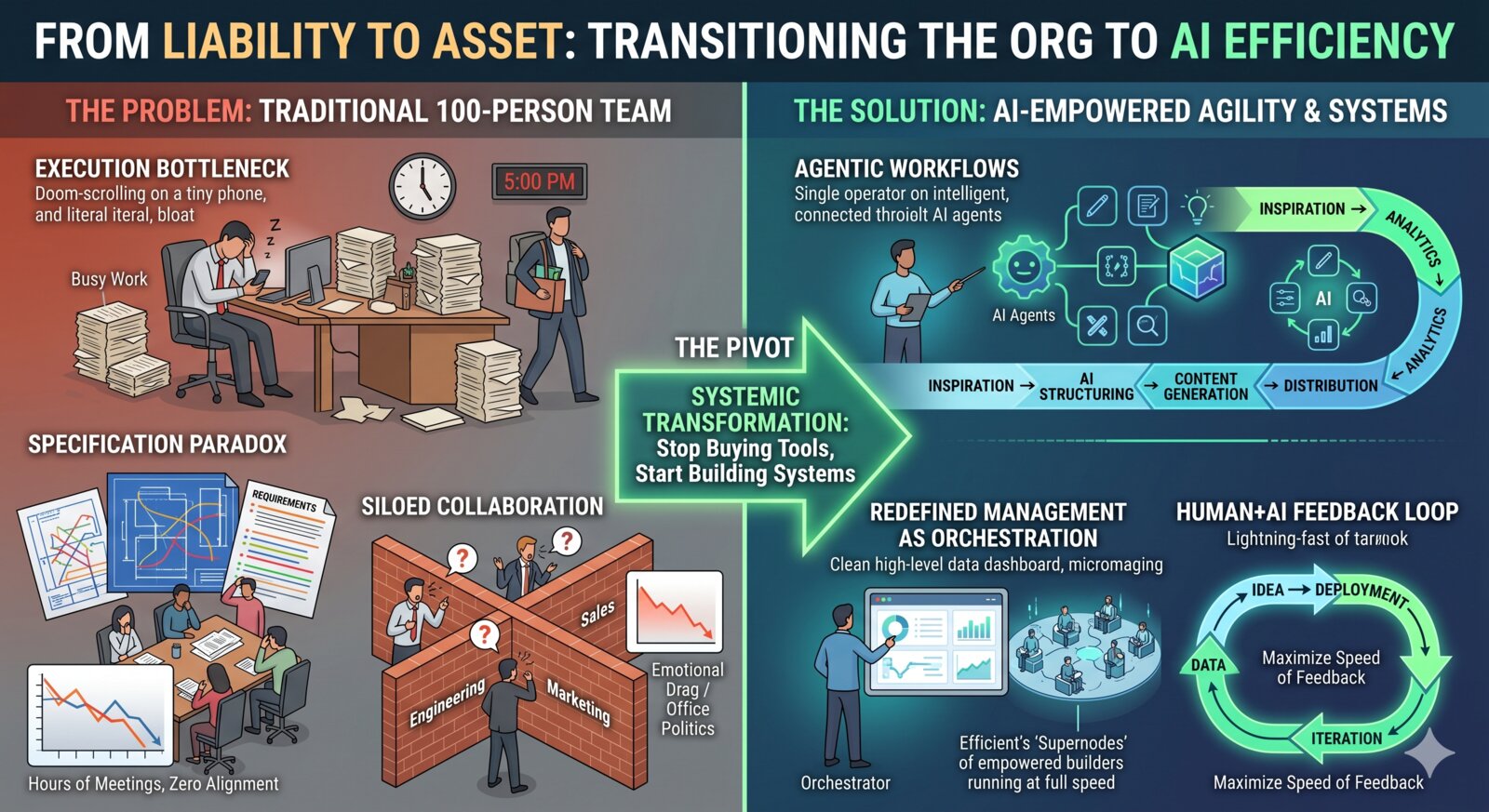
Look back at traditional 50–200 person companies and the structural decay becomes absurd. What we used to accept as "big company disease" is now an existential risk. AI has pushed individual output to terrifying levels, and these aren't just "diseases" anymore — they are massive financial liabilities.
The five patterns below all share the same root: each one assumes humans are the only execution path, when in 2026 they shouldn't be.
The Pragmatic Solution: Stop Buying Tools, Start Building Systems
1. Redefine Management as Orchestration
You cannot fix this by buying your team ChatGPT subscriptions. You have to break the traditional structure.
Let the people who actually build things run full speed with AI. Push management back to handle the slow, ambiguous external variables: market strategy, sales relationships, and deep user feedback. Mid-level managers who currently track tasks should be running customer development instead — that's where humans still hold the edge.
2. Deploy Agentic Workflows, Not Just Chatbots
Stop using AI for mere text generation. Build systems where AI agents handle the entire loop — from content structuring and generation to distribution and analyzing SEO feedback metrics.
A ChatGPT subscription per seat isn't a strategy; an end-to-end agentic pipeline is. The difference shows up immediately in the ratio of "human review time" to "work shipped".
3. Optimize for the Human + AI Feedback Loop
The future isn't about headcount. It's about how fast your organization can move from inspiration to deployment to data-driven iteration.
The metric that matters isn't "how many engineers do we have?" — it's "how many days from idea to live A/B test?" An org of 10 people running tight feedback loops will beat an org of 100 stuck in spec-and-review purgatory.
Five Liabilities Hiding in Your Org Chart
The five liabilities to spot:
| Problem | Symptom You See Daily | Why AI Changes the Math |
|---|---|---|
| Execution Bottleneck | Coasting until 5 PM, busy-work theater | Agentic workflows handle rote execution end-to-end |
| Specification Paradox | Hours of meetings, zero alignment | If you can spec it clearly to a human, feed it to an LLM |
| Directionless Management | New strategy Monday, new pivot Tuesday | Managers should orchestrate outcomes, not track tasks |
| Siloed Collaboration | Cross-team diplomatic negotiations | Shared agentic pipelines collapse the walls |
| Emotional Drag | Anxiety rolls downhill, mental check-out up | Energy flows to building, not politics |
> Humans should handle ambiguity; AI should handle execution.
We used to pretend this was unavoidable. AI has changed the math.
Tools & Resources
Learn about the best tools available...
Map, Redesign, Pilot — How We Work With SMB Leaders
We consult with SMB leaders who don't want to be the next cautionary tale. We don't guess.
1. Map your current human-to-human friction points — meetings, handoffs, requirements loops. Where does ambiguity die in a slide deck? Where does execution stall in a Jira ticket?
2. Identify which 20% of roles are vulnerable — not to fire, but to redesign. Which jobs are mostly orchestration that an agentic workflow can absorb?
3. Build a 90-day AI + org pilot that keeps morale high and speed measurable. Pick one workflow, instrument the before/after, ship the agentic version, prove the lift.
> You don't need to become a solo founder. You need to stop running a 100-person org like it's 2019.
Restructure, or Watch a Competitor + AI Do It for You
The choice for SMB leadership is binary. Restructure to empower your top 10% to operate like a fleet of one-person powerhouses, or watch a single competitor with AI absolutely demolish your 100-person team.
Those traditional roles you think are assets today? They'll be balance-sheet liabilities by next year. The window to redesign with morale intact closes faster than most leaders realize — by the time the headcount-vs-output ratio is visible to investors, the redesign is no longer a choice.
Take the next step
Putting what you read into practice.
Browse related topics
More templates and prompts in these areas.
Related Articles
AI Strategy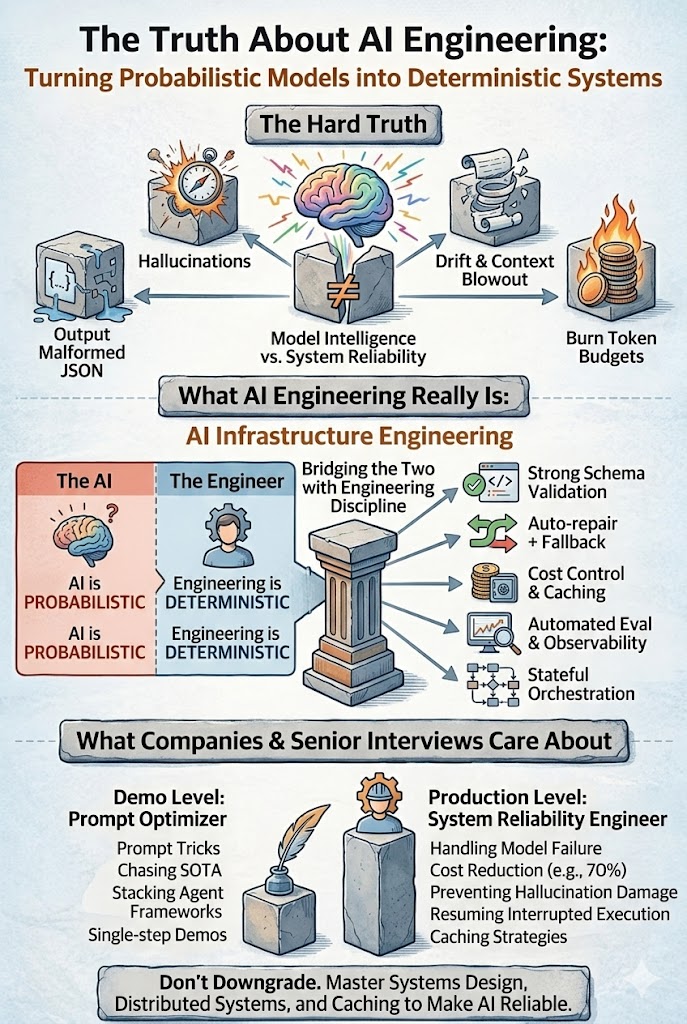
From Probabilistic to Deterministic: Hard Truths About AI Engineering in Production
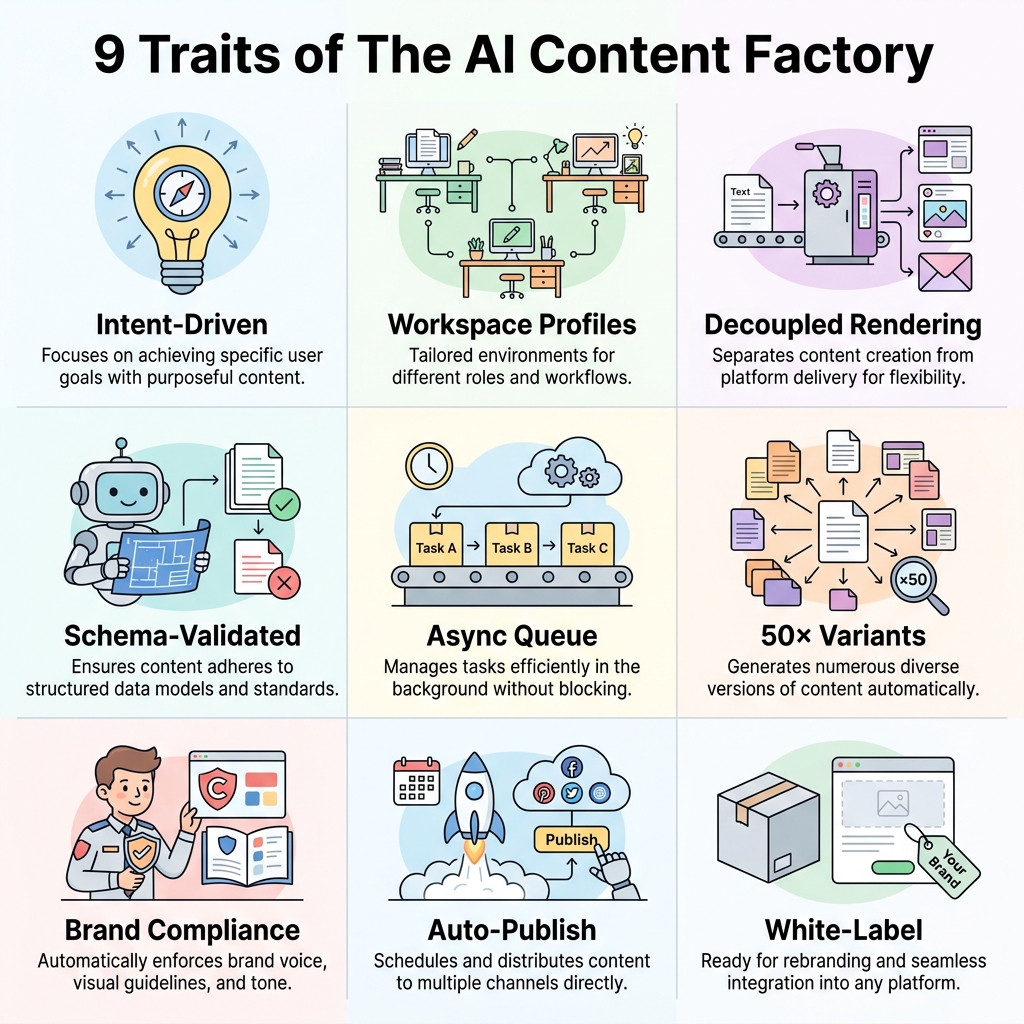
The AI Content Factory: Why Marketing Agencies Need to Stop Buying Tools and Start Building Pipelines