AI's Last Mile Problem: Why More Tokens Won't Deploy AI
The AI token race is loud. Enterprises measure progress in token consumption — background agents, autonomous coding loops, internal leaderboards — under the assumption that more tokens equal more productivity. The result is runaway costs (Uber capped engineer spend at $1,500/month after the bill scared the CFO), accumulating technical debt, and ROI nobody can quantify. It's a race to burn, not a race to solve. The real bottleneck isn't fluency. It's the last mile.
Tokens give fluency. The last mile gives deployability.
Fluency is what large models already do well — read the prompt, write the answer, fit the register, hit the tone. Tokens buy more of that. Whether the output can actually be *deployed* — fits real-world constraints, formats, and workflows — is a different engineering problem entirely. That's the last mile, and it doesn't get cheaper when you buy more tokens.
The pattern repeats across verticals: AI produces something that looks right at the screen-pixel level but breaks the moment it hits a production system. The fix isn't more fluency; it's the constraint layer between fluency and the system.
What goes wrong in three verticals
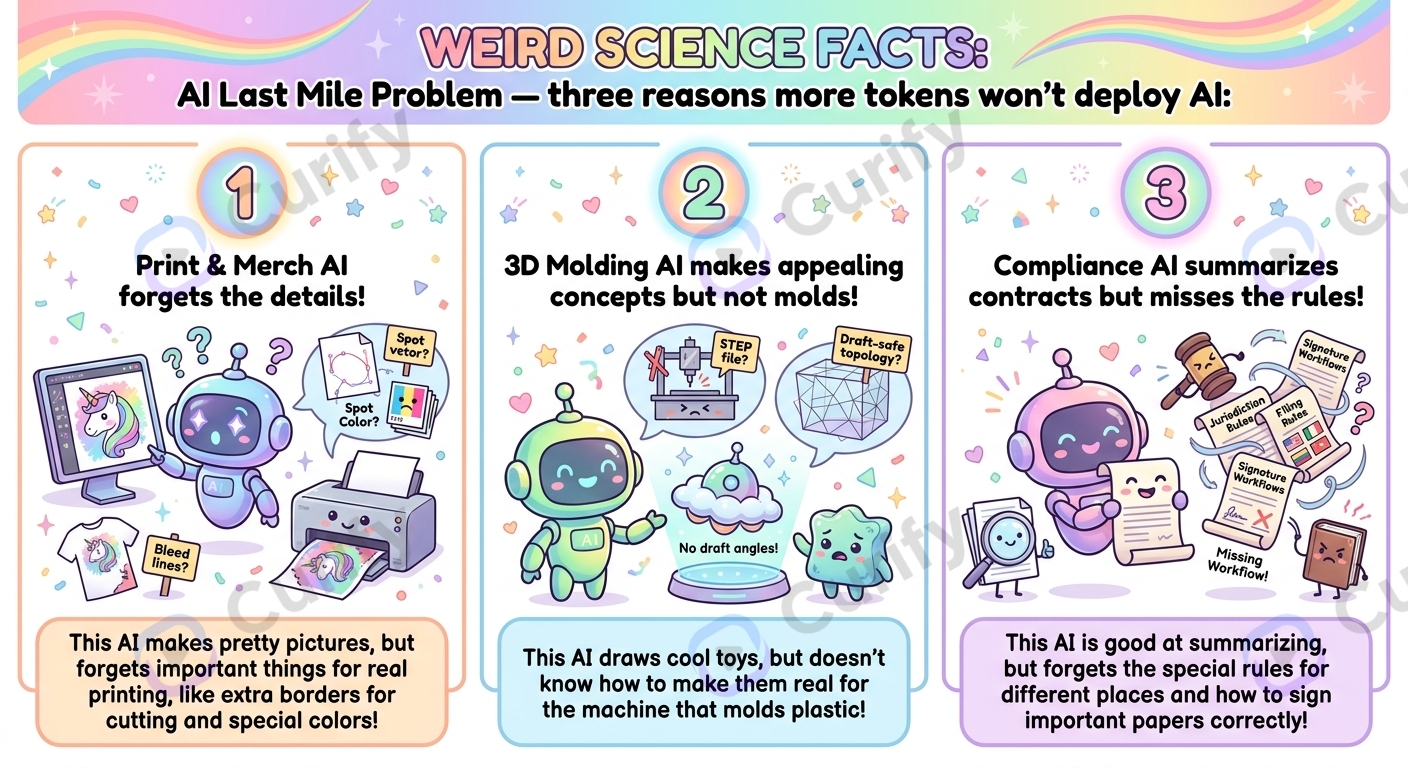
Print & merchandise. AI makes beautiful raster art for stickers, badges, t-shirts, and card decks — and forgets bleed lines, spot colors, vector closures, and CMYK profiles. Walk into any print-on-demand shop with the JPEG and you'll re-do half the file. The last mile here is raster → vector + bleed + color profile. See /use-cases/for-merch-operators for the operating model.
3D molding & industrial design. AI generates appealing 3D concepts but not draft angles, draft-safe topology, or STEP files for CNC. The mold-shop conversation ends at *"this won't pull from the cavity"*. The last mile is mesh → parametric CAD constraints. Adjacent reading: our industrial AI for illustrator IP case study on the same problem in 文创 production.
Legal & compliance. AI summarizes contracts well, but misses jurisdiction-specific filing rules and signature workflows. The summary is correct; the artifact still can't be filed. The last mile is free text → forms + validation rules.
Healthcare belongs on the same list — AI nails symptom checkers, but not HL7/FHIR integration with hospital scheduling. The pattern is identical: fluency at the front, constraint layer at the back.
Tools & Resources
Learn about the best tools available...
Where Curify works on the last mile
Curify's bet is that the last mile is *templatable* per vertical. We don't sell more tokens; we sell the constraint layer that turns AI fluency into deployable artifacts in specific domains.
Today that means three concrete tracks:
- Merch & print-on-demand — IP-themed mockups, sticker sheets, gift-box packaging, character sprite sheets, all rendered with the constraints real print pipelines need.
- Publisher & EdTech bilingual content — templated nano-template inspirations across 10 locales, with auto-tagged search aliases and human review in the loop.
- Programmatic SEO — visual-first hub pages that actually rank, not the listicle slop that Google's anti-Slop penalty was written for.
Each track is a vertical interpretation of the same principle: stop scaling the token count, start scaling the constraint layer. See the event card case study for a worked example — bilingual print collateral where Manus and Genspark failed the brief and HTML+CSS shipped print-ready.
Stop tokenmaxxing. Start engineering the last meter.
Three principles for AI work in 2026:
1. Pick the shift, not the scale. Raster → vector + bleed + color (print). Mesh → parametric CAD constraints (molding). Free text → forms + validation (compliance). The shift is the unit of progress.
2. Measure deployable artifacts, not token spend. Tokens are an input metric, not an outcome. Count what made it to a real customer or a real production system.
3. The vertical is the leverage. Generic AI scales fluency. Vertical AI scales the constraint layer. The verticals worth building are the ones with a known last-mile transformation between AI output and production input.
If you're running into the last-mile gap in publishing, merch design, or programmatic SEO, we've shipped the playbook — for-publishers, for-merch-operators, for-programmatic-seo. Talk to us.
Take the next step
Putting what you read into practice.
Browse related topics
More templates and prompts in these areas.
Related Articles
AI Strategy
Industrial-Grade AI for Illustrator IP: Why Generic Models Fail on Series Consistency, Pattern Precision, and Print Readiness

AI Event Card: Manus, Genspark, and What Actually Printed