Evaluating Agentic Generative Capability: Curify vs. GPT vs. Canva AI
As AI visual generation enters its next phase, simply producing a first-pass “text-to-image” draft is no longer a meaningful differentiator. When a user enters a query, the real competition is not which platform can create the prettiest image, but which system demonstrates stronger agentic capability through its ability to understand intent, make structured creative decisions, and turn an AI-generated draft into a usable, high-precision, commercial-grade asset. This article examines the core differences among Curify, ChatGPT, and Canva, following the workflow from intent understanding to commercial delivery, and explains how these differences are reshaping visual production.
1. Where Are the Differences?
To compare these three platforms fairly, we need a clear evaluation framework, which we call the 3-Tier Ontology. In practice, this framework asks whether a system can accurately understand and generate three layers of a query at the same time, including the subject or event, the type of information being conveyed, and the intended style and layout.
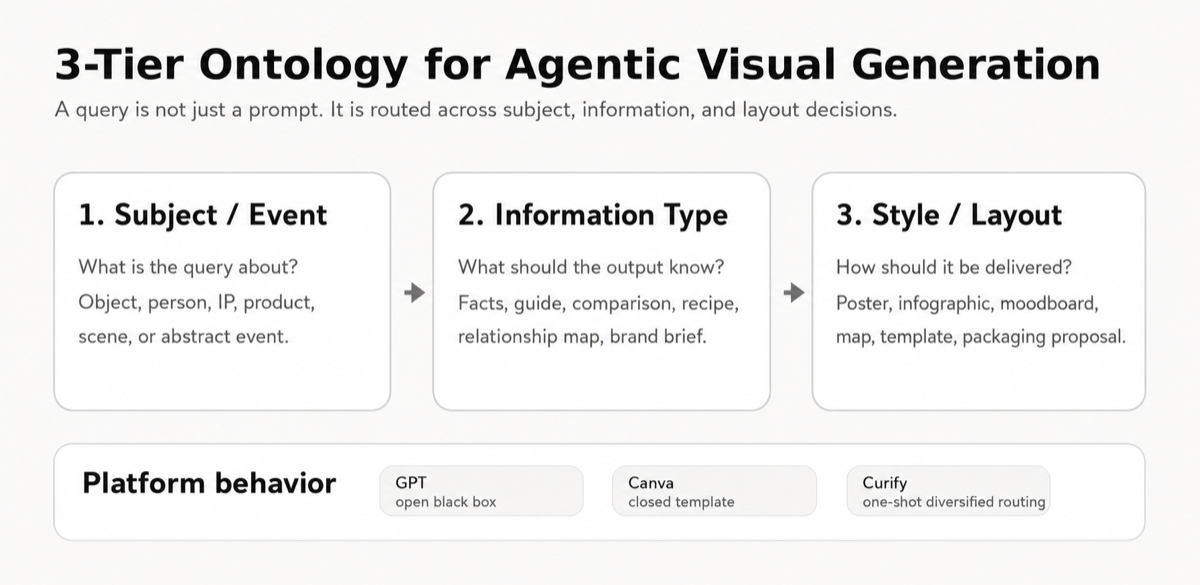
Under this evaluation basis, the main differences among the three platforms appear in the following dimensions.
1.1 Guidance Mechanism: Open Black Box vs. Closed Template vs. Intelligent Distribution
GPT: an open black box.
It depends heavily on prompt engineering. It is open and flexible, but it requires the user to already have a very clear visual concept and logical structure in mind. Without strong guidance, it often returns the most generic default answer.
Canva AI: a closed template system.
Its guidance is shaped by the templates users choose. In most cases, Canva begins from a predefined format, such as a poster layout or design frame, and the AI mainly helps fill in the visual elements within that structure.
Curify: intelligent one-shot distribution.
It reduces the user’s prompt burden by using built-in agent routing to generate several clearly differentiated creative directions at once. This one-shot diversity allows the system to do much of the brainstorming for the user, rather than expecting the user to define every direction up front.
1.2 Visual Impact vs. Information Density: Same-Query Stress Test
When we use specific queries for stress testing, the gap between platforms becomes clear in how they select and load information.
Query A: “Fun Economics”
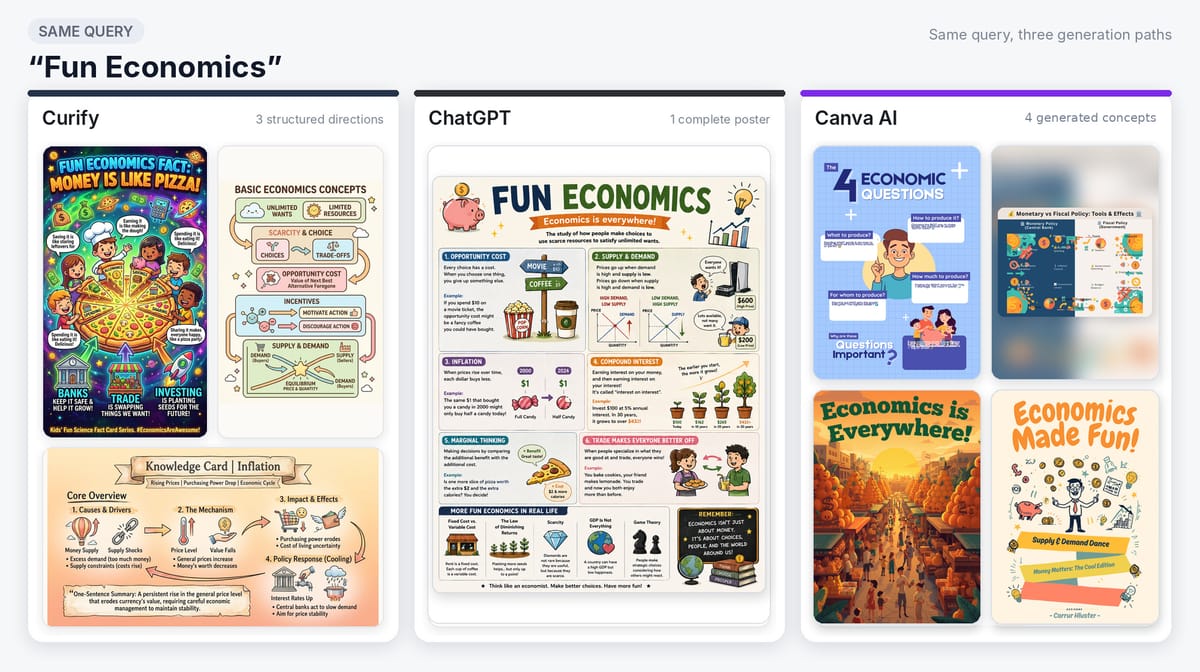
GPT (single-path synthesis):
It turns the query into one comprehensive educational poster. Its output covers a broad range of core concepts, including opportunity cost, supply and demand, inflation, compound interest, marginal thinking, trade, scarcity, diminishing returns, and game theory. Definitions, everyday examples, diagrams, and illustrations are organized into a clear one-page narrative. The result is polished and easy to follow, but GPT commits to a single editorial direction, with limited variation in audience, format, or analytical framing.
Canva AI (multi-concept, template-led exploration):
It generates four visually distinct concepts, including an introduction to the four economic questions, a comparison of monetary and fiscal policy, a marketplace-themed “Economics Is Everywhere” poster, and a playful economics infographic. This provides more topical and stylistic variety than a single template. However, the information depth and layout quality vary across the outputs. Some concepts are primarily visual, while others contain crowded or unevenly structured text, meaning the user may still need to refine the content, correct the layout, and validate the information before publishing.
Curify (structured multi-direction generation):
It produces three high-information-density assets that explore different economic topics and information structures rather than simply restyling the same poster.
- Personal finance visualization: a playful pizza metaphor that explains how money can be divided across different financial choices.
- Core-concept map: a structured overview connecting scarcity, choice, opportunity cost, incentives, and supply and demand.
- Analytical knowledge card: a framework that organizes inflation through Cause & Drivers → Mechanism → Impact & Effects → Policy Response.
The key difference is that Curify varies both the subject matter and the information architecture across its outputs, giving the user several distinct directions to evaluate from a single query.
Query B: “Chiikawa” (Well-Known IP)
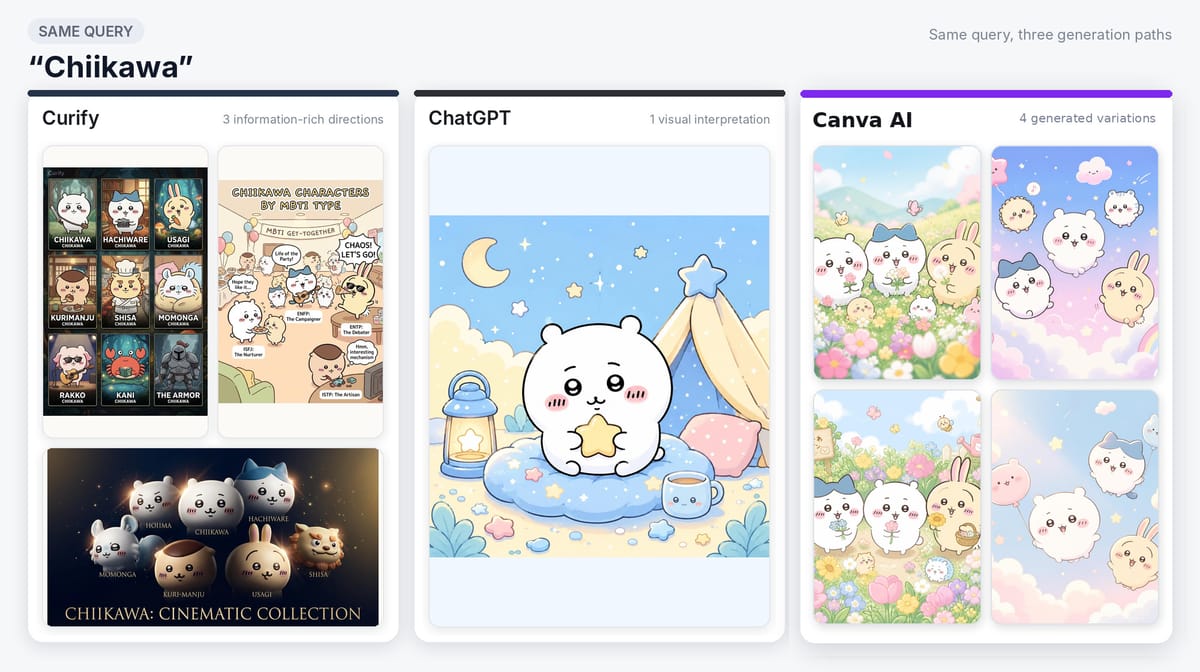
GPT / Canva:
They mainly present the subject visually by generating cute character images. These outputs may even contain hallucination errors from large models.
Curify (visuals + information):
Curify not only generates the character, but also automatically adds information layers based on the ontology, such as relationship maps and personality tags.
Query C: “Reading Aesthetics” — Finding the Boundary of Capability
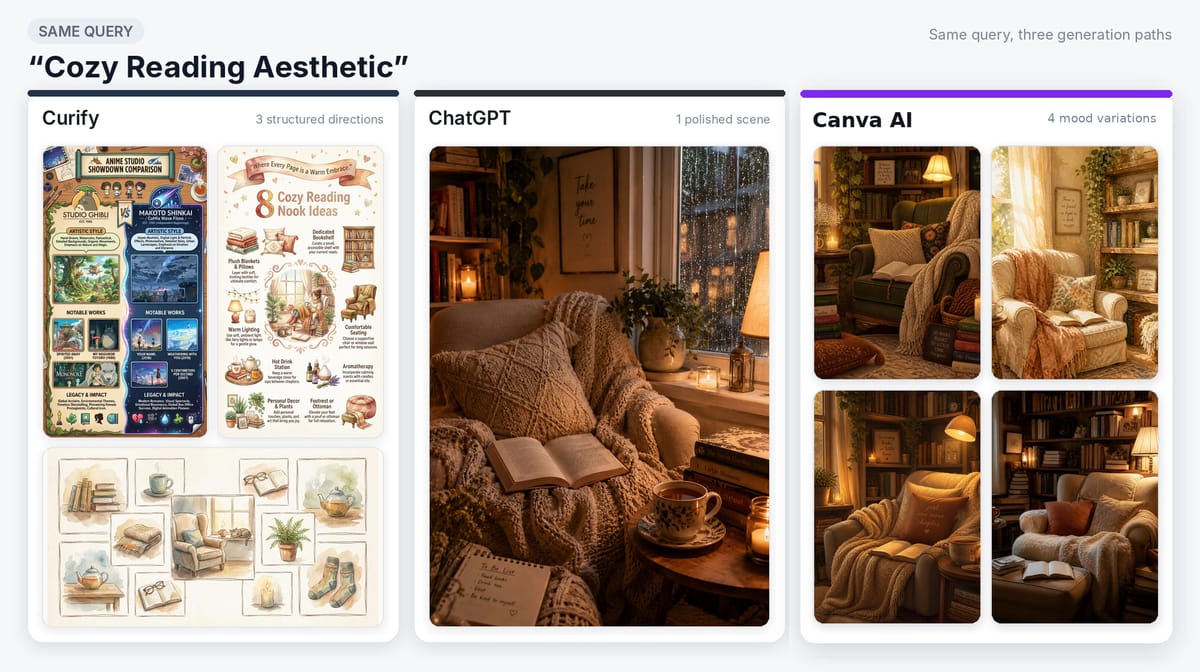
GPT:
It can generate a very beautiful reading scene.
Canva:
It can generate multiple attractive mood images and provide design directions suitable for social media.
Curify:
Based on the meaning of the query, Curify can automatically extend the output into a DIY guide or a color-and-product selection card.
2. What Value Do These Differences Create? The Value of Deterministic Output
If GPT is a creative sandbox and Canva is a design canvas, Curify’s defining value is its ability to turn inspiration into production-ready commercial assets. What may appear to be small differences in information density and output diversity actually speaks directly to the core needs of B2B users, from designers and brand marketers to merchants.
Business Case: A Step-Change Advantage for Brand Packaging Proposals
The tea packaging example below shows how Curify’s agentic capabilities translate into real commercial leverage. In the past, when a designer needed to prepare a proposal for an “Oriental botanical herbal tea” packaging concept, the process usually meant pulling dozens of reference images from Pinterest and manually assembling them into a moodboard in Photoshop. With Curify, the workflow is much simpler. The user only needs to provide a brief, and the system automatically generates three distinctly different creative directions, each with its own layout and color palette.
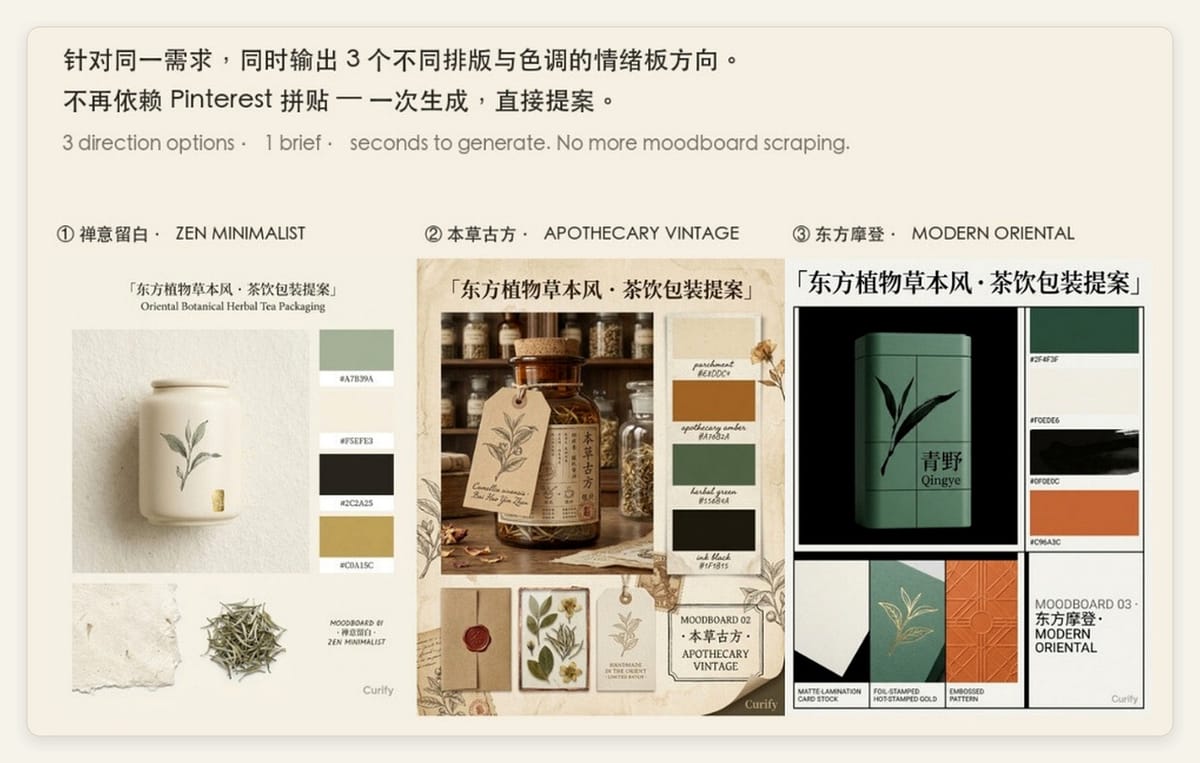
- Zen Minimalist: a minimal main visual + a light color palette.
- Apothecary Vintage: a complex kraft-paper vintage layout + wax-seal material references.
- Modern Oriental: high-contrast modern color blocks + hot-stamping and embossed material details.
Curify’s generative capability delivers three irreplaceable business values:
- 3x faster proposal development: It removes the friction of early-stage image searching and concept building. One generation can cover different client aesthetic preferences.
- A complete layout system with strong visual consistency: Each direction includes not only a hero visual, but also a curated color palette and texture references within the same frame, aligning naturally with professional design presentation standards.
- Ready to present, with no extra layout work: The exported files have high information density and professional layout quality. They can be packaged and sent directly to clients for direction-setting.
3. Conclusion: The Real Winner Is the Platform That Understands the Task
AI visual generation is moving from prompt-to-image to brief-to-asset. The winning platform is not simply the one that creates the most stunning image. It is the one that best understands the task behind the query. GPT is strong at open-ended generation. Canva is strong at editable design production. Curify is strong at intelligent exploration and structured one-shot diversity.
For individual users, this may simply be a convenience upgrade. For B2B teams, it changes the structure of the workflow itself. Curify bridges one of the hardest gaps in visual production by transforming an initial idea into several credible creative directions that can be presented, discussed, and further developed.
This is the value of Agentic Generative Capability. It turns AI from a drawing tool into a visual productivity system. It does not just generate images. It helps teams make decisions faster, align with clients more clearly, and deliver commercial assets more efficiently.
Take the next step
Putting what you read into practice.
Browse related topics
More templates and prompts in these areas.
Related Articles
Creator Tools
Midjourney vs DALL-E 3 vs Nano Banana vs Stable Diffusion (2026)
Competitor Comparison Infographics with AI: A 3-Tier Composable Workflow