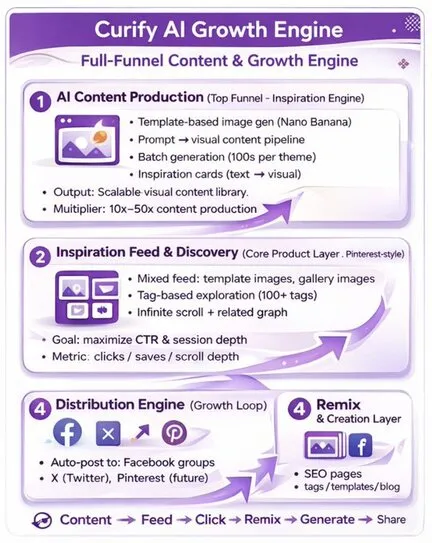
From 4000 Images to 50 Meaningful Tags: Building Pinterest-Style Content Discovery
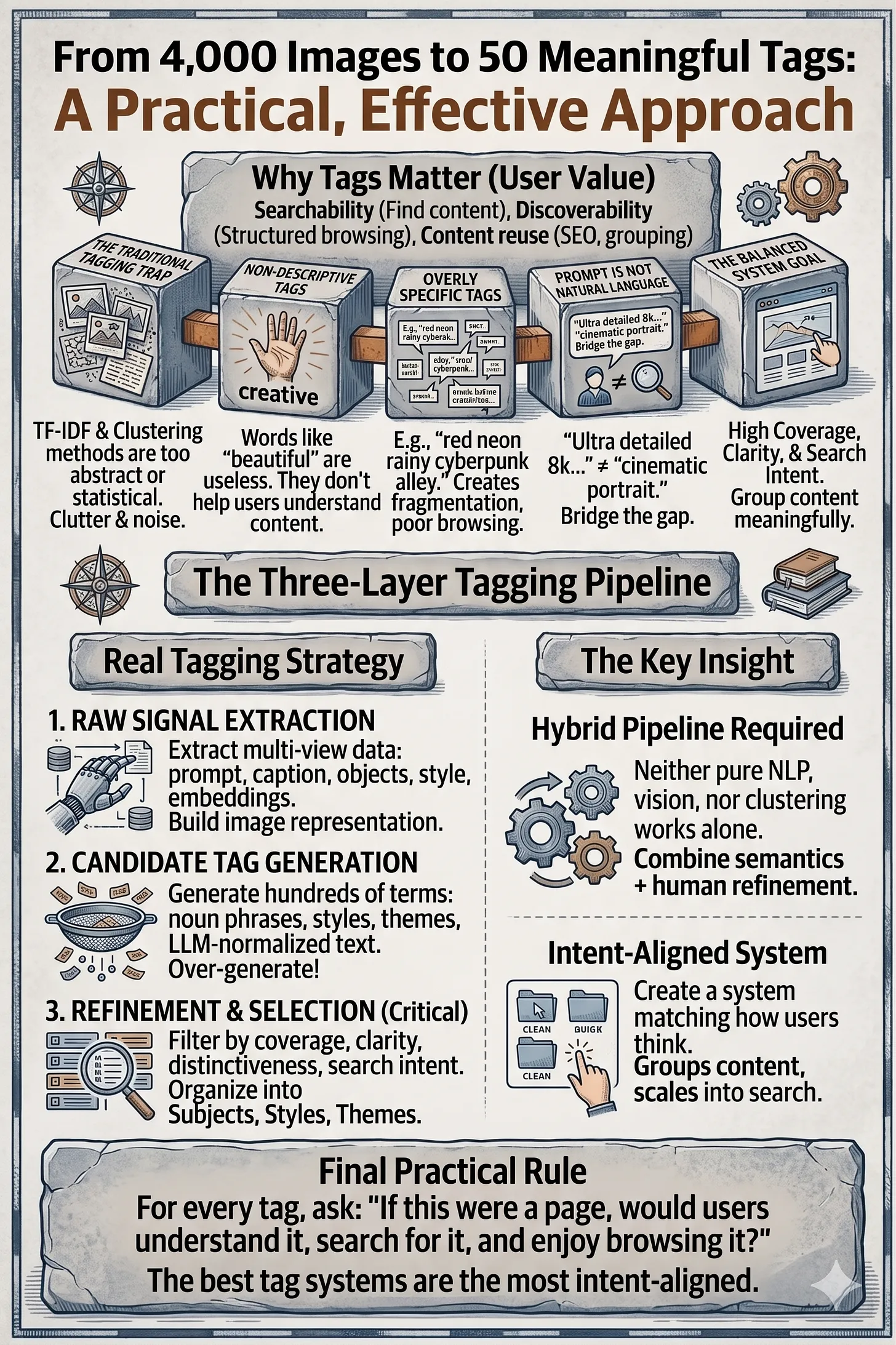
When you have thousands of images (and prompts), generating a clean set of 40–50 meaningful tags sounds straightforward — but it's surprisingly tricky.
This is not just a labeling problem. It's a product problem.
Why Tags Matter (User Value)
A good tagging system directly improves:
ð Searchability
users can find what they want with natural queries
ð Discoverability
browsing becomes structured and enjoyable
ð Content reuse
tags enable grouping, recommendation, and SEO pages
If done well, each tag can become a landing page that users actually want to explore.
The Core Challenges
Non-descriptive tags
Some tags sound valid but are useless:
"creative"
"beautiful"
"modern"
They don't help users understand what they'll get.
Overly specific (rare) tags
Some tags are too granular:
"red neon rainy cyberpunk alley at night"
- too few images per tag
- poor browsing experience
- low search value
Prompt ≠ Natural Language
Prompts are not how users search.
Prompt:
"ultra detailed cinematic lighting 8k masterpiece…"
User search:
"cinematic portrait"
Bridging this gap is critical.
Traditional methods fall short
TF-IDF / keyword extraction and image clustering have limitations:
TF-IDF / keyword extraction
Good at frequency
Bad at meaning and grouping
Image clustering
Captures global similarity
Misses concrete, user-facing concepts (e.g., "cat", "poster", "anime")
In short: too statistical, too abstract
A Three-Layer Tagging Approach
A practical solution is to combine structure + semantics + human refinement.
Layer 1 Raw Signal Extraction
For each image, extract structured metadata:
prompt text
the original AI prompt
visual caption
via vision model
objects/entities
e.g., "cat", "city", "dress"
style
e.g., "anime", "watercolor"
embeddings
for similarity
This gives you a multi-view representation of each image.
Layer 2 Candidate Tag Generation
Instead of jumping to 50 tags, first generate hundreds of candidates:
noun phrases
("neon city", "traditional dress")
style terms
("cinematic", "3D render")
themes
("fantasy", "travel")
cluster labels
(from embedding clustering)
LLM-normalized phrases
("realistic portrait" instead of prompt noise)
At this stage, over-generate.
Layer 3 Refinement & Selection (Critical)
blog.contentTaggingSystem.threeLayerApproach.layer3.description
Filter Criteria:
blog.contentTaggingSystem.threeLayerApproach.layer3.criteria.coverage
blog.contentTaggingSystem.threeLayerApproach.layer3.criteria.coverageDesc
blog.contentTaggingSystem.threeLayerApproach.layer3.criteria.clarity
blog.contentTaggingSystem.threeLayerApproach.layer3.criteria.clarityDesc
blog.contentTaggingSystem.threeLayerApproach.layer3.criteria.distinctiveness
blog.contentTaggingSystem.threeLayerApproach.layer3.criteria.distinctivenessDesc
blog.contentTaggingSystem.threeLayerApproach.layer3.criteria.searchIntent
blog.contentTaggingSystem.threeLayerApproach.layer3.criteria.searchIntentDesc
blog.contentTaggingSystem.threeLayerApproach.layer3.organization.title
blog.contentTaggingSystem.threeLayerApproach.layer3.organization.subject
blog.contentTaggingSystem.threeLayerApproach.layer3.organization.subjectDesc
blog.contentTaggingSystem.threeLayerApproach.layer3.organization.style
blog.contentTaggingSystem.threeLayerApproach.layer3.organization.styleDesc
blog.contentTaggingSystem.threeLayerApproach.layer3.organization.theme
blog.contentTaggingSystem.threeLayerApproach.layer3.organization.themeDesc
blog.contentTaggingSystem.threeLayerApproach.layer3.organization.useCase
blog.contentTaggingSystem.threeLayerApproach.layer3.organization.useCaseDesc
blog.contentTaggingSystem.threeLayerApproach.layer3.organization.mood
blog.contentTaggingSystem.threeLayerApproach.layer3.organization.moodDesc
blog.contentTaggingSystem.keyInsight.title
blog.contentTaggingSystem.keyInsight.description
blog.contentTaggingSystem.keyInsight.solution
blog.contentTaggingSystem.pinterestPlatform.title
blog.contentTaggingSystem.pinterestPlatform.description
blog.contentTaggingSystem.pinterestPlatform.galleryTags.title
blog.contentTaggingSystem.pinterestPlatform.galleryTags.description
blog.contentTaggingSystem.pinterestPlatform.galleryTags.examples.subject
blog.contentTaggingSystem.pinterestPlatform.galleryTags.examples.subjectDesc
blog.contentTaggingSystem.pinterestPlatform.galleryTags.examples.style
blog.contentTaggingSystem.pinterestPlatform.galleryTags.examples.styleDesc
blog.contentTaggingSystem.pinterestPlatform.galleryTags.examples.medium
blog.contentTaggingSystem.pinterestPlatform.galleryTags.examples.mediumDesc
blog.contentTaggingSystem.pinterestPlatform.galleryTags.examples.mood
blog.contentTaggingSystem.pinterestPlatform.galleryTags.examples.moodDesc
blog.contentTaggingSystem.pinterestPlatform.galleryTags.examples.composition
blog.contentTaggingSystem.pinterestPlatform.galleryTags.examples.compositionDesc
blog.contentTaggingSystem.pinterestPlatform.galleryTags.examples.color
blog.contentTaggingSystem.pinterestPlatform.galleryTags.examples.colorDesc
blog.contentTaggingSystem.pinterestPlatform.templateTags.title
blog.contentTaggingSystem.pinterestPlatform.templateTags.description
blog.contentTaggingSystem.pinterestPlatform.templateTags.geoTags.title
blog.contentTaggingSystem.pinterestPlatform.templateTags.geoTags.description
blog.contentTaggingSystem.pinterestPlatform.templateTags.languageTags.title
blog.contentTaggingSystem.pinterestPlatform.templateTags.languageTags.description
blog.contentTaggingSystem.ruleOfThumb.title
blog.contentTaggingSystem.ruleOfThumb.question
"blog.contentTaggingSystem.ruleOfThumb.description"
blog.contentTaggingSystem.ruleOfThumb.action
blog.contentTaggingSystem.finalThought.title
blog.contentTaggingSystem.finalThought.description
blog.contentTaggingSystem.finalThought.conclusion
Take the next step
Putting what you read into practice.
Browse related topics
More templates and prompts in these areas.