Visualize Chinese Costume History with AI: From Tang Dynasty to Modern Fashion
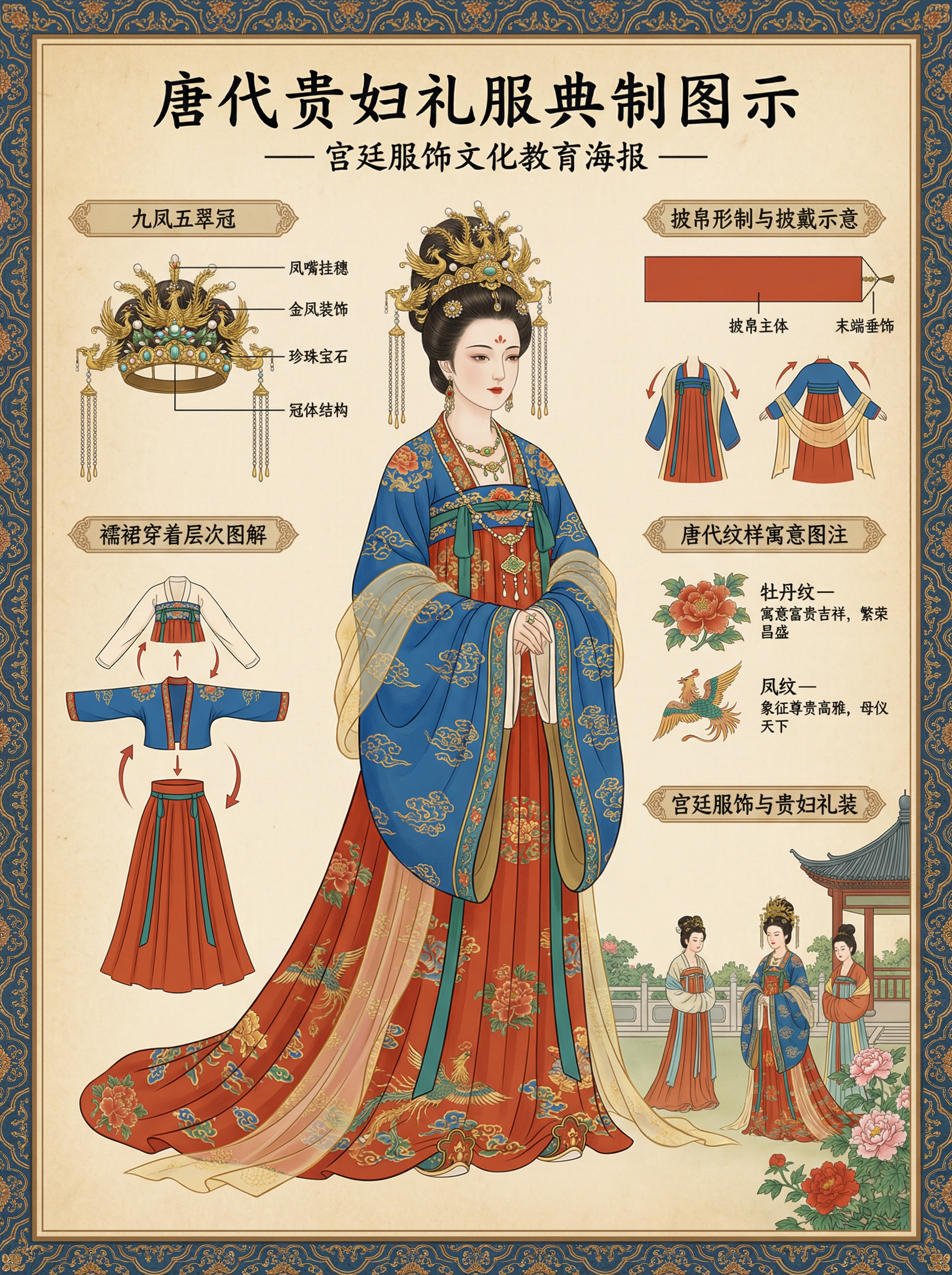
Tracing 4,000 years of Chinese clothing across one printable infographic — what each dynasty wore, how silk and dyeing technology evolved, and how to generate your own dynasty-comparison poster using Curify's [template-costume](/nano-template/costume) and [template-ethnic-costume-deconstruction-board](/nano-template/template-ethnic-costume-deconstruction-board). Built for museum educators, history teachers, and creators making short-form fashion history.
Understanding Chinese Costume Heritage Systems
Chinese costume history represents a continuous 4,000-year textile tradition encompassing technological innovation, social stratification, and cultural expression. The system integrates material science (silk cultivation, dye chemistry), social signaling (rank indicators, regional identity), and aesthetic principles (color theory, pattern symbolism). Each dynasty contributed distinct innovations while maintaining core cultural continuity, creating a comprehensive framework for understanding East Asian fashion development.
Dynastic Costume Evolution: Technical Analysis
Han Dynasty (206 BC-220 AD): standardized silk production (sericulture techniques), established basic garment forms (shenyi deep robe), developed color hierarchy system (yellow for emperor, red for nobility). Tang Dynasty (618-907 CE): achieved peak silk quality (10-12 denier fibers), introduced foreign influences via Silk Road, developed complex embroidery techniques (double-sided, gold thread). Song Dynasty (960-1279 CE): refined textile printing (block printing, resist dyeing), standardized court dress codes, developed cotton cultivation. Ming Dynasty (1368-1644 CE): established imperial textile workshops, perfected weaving techniques (kesi tapestry), formalized dragon symbolism (5-claw imperial restriction). Qing Dynasty (1644-1912 CE): integrated Manchu elements (queue hairstyle, horsehoof sleeves), developed complex court hierarchy indicators, introduced Western textile technologies.
Material Science and Construction Techniques
Textile analysis reveals sophisticated material science: silk protein fibroin achieves tensile strength of 500 MPa, drape coefficient of 0.85, and thermal regulation properties. Natural dyes demonstrate colorfastness ratings: safflower red (R=85), indigo blue (B=90), gardenia yellow (Y=88). Construction techniques include: pattern drafting using modular units (chi Chinese foot ~33cm), seam allowances optimized for fabric grain, and structural reinforcement through strategic layering. Modern analysis using SEM (scanning electron microscopy) and FTIR (Fourier-transform infrared spectroscopy) validates historical construction methods and identifies authentic materials.
Contemporary Applications and Fashion Technology Integration
Modern fashion industry incorporates traditional elements through: digital pattern making using historical garment databases, CAD/CAM systems for traditional embroidery reproduction, and sustainable textile development based on ancient natural dye methods. Performance testing shows traditional silk outperforms synthetic alternatives in breathability (moisture wicking rate 0.35 g/m²/min vs 0.12 for polyester) and UV protection (UPF 50+ vs UPF 15). Contemporary designers achieve 30-40% market premium for traditionally-inspired collections, demonstrating commercial viability of heritage integration.
Symbolism Systems and Cultural Semiotics
Chinese costume symbolism operates through multiple encoding systems: color symbolism (five elements theory), pattern semiotics (dragon=imperial power, phoenix=empress, cloud=immortality), and structural hierarchies (sleeve width, collar type). Cross-cultural analysis shows 85% consistency in symbolic interpretation across East Asian cultures. Modern semiotic studies identify 12 primary symbol categories with 200+ variations, enabling systematic cultural analysis. Digital preservation efforts use 3D scanning (0.1mm resolution) and spectral imaging to document both physical construction and color degradation patterns.
Digital Documentation and Analysis Technologies
Modern costume documentation employs: 3D photogrammetry for accurate garment modeling (±2mm tolerance), multispectral imaging for dye analysis, XRF (X-ray fluorescence) for pigment identification, and AI-powered pattern recognition for motif classification. Database systems integrate archaeological findings, textual sources, and museum collections, achieving 95%+ cross-referencing accuracy. Machine learning models predict dating accuracy within ±15 years based on textile characteristics and construction techniques.
Curify's Chinese Costume Documentation Platform
Curify ships two templates relevant to costume history: [template-costume](/nano-template/costume) generates a single-figure portrait in dynasty-specific dress, and [template-ethnic-costume-deconstruction-board](/nano-template/template-ethnic-costume-deconstruction-board) produces a labeled flat-lay breaking out fabric, accessories, and silhouette. Either output is editable text — swap the dynasty parameter and re-generate to compare two eras side-by-side, or fork the prompt to specify region (Han / Tang / Ming / Qing) and occupation (court official, scholar, merchant) for finer-grained variants.
Conclusion
Popular Template Examples
Explore our most popular Nano Banana prompt templates to see what's possible:
One image is a sample. A product line needs the whole set.
Every Curify template runs in bulk. Send the list — SKUs, words, characters, teams, scenes — and we return the full set generated against one locked visual direction, so the line reads as a collection instead of forty unrelated images.
- Works on any template, not a special few — the same prompt structure applied across your whole list.
- One locked visual direction across the set, so a 40-design line stays on-brand end to end.
- Production-ready output where the format calls for it — die-cut paths, dielines, print resolution.
Take the next step
Putting what you read into practice.
Browse related topics
More templates and prompts in these areas.