Best Programmatic SEO Tools in 2026: AirOps vs Webflow vs WordPress at Scale
Most "best programmatic SEO tools" lists pad to 15 entries because padding helps SEO. We disagree. Three tools cover almost every real workflow in 2026 — AI-native generation with built-in QA and AEO tracking (AirOps), visual-builder + CMS with AI search optimization baked in (Webflow), and old-school code-aware scale (WordPress + WP All Import). New in 2026: "programmatic SEO" now means both ranking on Google **and** being cited by LLMs (ChatGPT, Perplexity, Gemini). All three tools below address this, in different ways. We pick the three, name what each is best at, and flag one common case (visual-heavy programmatic SEO — product variants, country-by-style permutations, fandom cards) where you should pair the tool above with a template-first visual generation layer.
Who this is for
Founders and growth marketers shipping programmatic landing pages at 100+ scale. Solo SEO operators running side projects with thousands of pages. Marketing teams at DTC brands generating product-variant pages, location pages, or use-case landing pages. Teams now also chasing LLM citations (AEO) on top of Google rankings. If you're trying to scale visual programmatic content — product photos by style + country, character cards by fandom, etc. — skip ahead to the What if generic AI generation isn't enough? callout. The three tools above handle the page infrastructure; visual content at scale needs a different layer.
Quick buyer's guide — what actually matters
Five dimensions matter; the rest is marketing copy.
1. Page-count ceiling. Programmatic SEO compounds with scale. A tool that ships your first 100 pages quickly but caps at 5,000 will force a migration when the strategy actually works. Check the vendor's published page-count limits, not just starter plans.
2. Quality control at scale. AI generation produces 10,000 thin pages without breaking a sweat. Google notices, and LLMs increasingly do too. The tool you pick should have either built-in QA workflows (AirOps does) or a clear pattern for human review at the scale you ship.
3. AEO / LLM visibility. New in 2026: half of programmatic SEO traffic now arrives via LLM citations (ChatGPT, Perplexity, Gemini, Google AI Mode) rather than classic SERPs. The tool you pick should track LLM visibility per page, not just Google rankings. AirOps purpose-built this; Webflow has it baked into AEO insights; WordPress requires a third-party tracker plugin.
4. Visual content handling. If every programmatic page needs the same hero image, generic stock works. If every page needs a unique on-brand visual — product variant, location-specific scene, character card — the page tool alone won't solve it. You'll pair it with a visual generation layer (e.g., template-first generation like Curify's).
5. CMS lock-in. Webflow's CMS is excellent but proprietary. WordPress is portable but high-maintenance. AirOps writes into your existing CMS via API — flexible but adds an integration layer. Pick based on whether you optimize for switching cost (low → WordPress) or for design quality (high → Webflow).
How we picked these three
Most "best programmatic SEO tools" lists are 15-20 entries padded for SEO purposes. We disagree. Three tools cover the three buyer profiles in programmatic SEO — AI-native + AEO with QA, visual-builder design-conscious, and code-aware old-school scale. We dropped tools that overlap with these three: Frase, Surfer SEO, MarketMuse, Clearscope sit in the content-optimization bucket (they help you write better content, not generate programmatic pages). Jasper, Copy.ai, WordHero sit in the general-purpose AI-writing bucket — capable for programmatic but without the QA workflows AirOps purpose-builds. Framer, Squarespace sit in the visual-builder bucket with Webflow but lack Webflow's CMS depth or AEO integration. Automation rails (Make, Zapier, n8n) are integration glue, not programmatic SEO platforms. If you want the long listicle, those are a Google search away.
The three tools worth comparing
Past the marketing copy, the programmatic SEO space sorts into three buckets: the AI-native platform with QA + AEO tracking (AirOps), the visual builder with design-first CMS and built-in AEO insights (Webflow), and the code-aware old-school scale approach (WordPress + WP All Import). Each owns a different buyer profile. Pick by your team's strongest competency.
1. AirOps
AI-native growth platform — programmatic SEO + AEO with built-in QA workflows
- Best for: AI-generated landing pages where quality control AND LLM citation tracking matter — generated drafts get human-in-the-loop review, then deploy + monitor for LLM visibility
- Pricing: Sales-led pricing (custom quotes); free trial available; transparent per-page costs not published
- Integrations: Webflow, WordPress, Shopify, custom CMS via API; tracks LLM citations across ChatGPT, Perplexity, Gemini, Google AI Mode
- Notable limitation: Sales-led pricing means opaque cost at scale; the platform is newer than WordPress / Webflow ecosystems (less third-party tooling); AI-first means less control over edge cases than custom-code approaches
Pick AirOps when you want AI generation + structured QA workflows + LLM visibility tracking without building any of it yourself. The killer features: (1) AI drafts a page, your team approves or edits, then it publishes to your CMS — the workflow that scales without Google noticing AI thinness; (2) per-page tracking of ChatGPT / Perplexity / Gemini citations so you measure AEO traffic directly. If you have a content team for review and want to ship 10k+ AI-generated pages a year while tracking LLM visibility, AirOps is the path.
2. Webflow
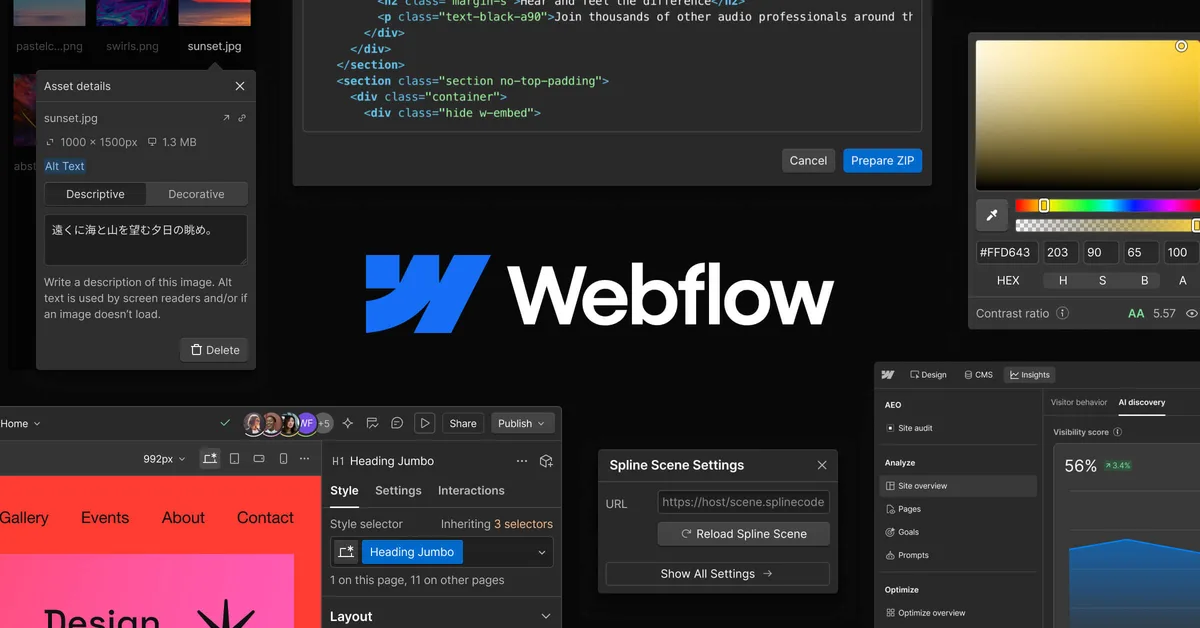
Visual builder + CMS, now with AEO insights baked in
- Best for: Brand-first marketing teams shipping hundreds to low thousands of programmatic pages with strong design control AND now AI search optimization
- Pricing: $23/mo Basic CMS → $49/mo CMS → $250+/mo Enterprise; CMS item caps apply per tier (2k items on Basic, 10k on CMS, more on Enterprise)
- Integrations: Native Webflow CMS, Webflow API for custom programmatic generation, Zapier / Make integrations; AEO insights panel ships with the Designer in 2026
- Notable limitation: CMS page limits in lower tiers (2k items on Basic, 10k on CMS); scaling past 50k pages hits real friction; per-page surcharges on high-volume Enterprise; AEO insights are page-level — less granular than AirOps' per-LLM citation tracking
Pick Webflow when visual brand control matters more than maximum scale and you're targeting hundreds to a few thousand pages. The design-first CMS produces programmatic pages that look hand-built — rare in the category. The 2026 AEO insights panel gives you page-level visibility into LLM citations without leaving the Designer. Pair with Make.com or AirOps for the content ingestion step. Hit Enterprise tier when you need >10k pages; consider migrating to WordPress if you cross 50k.
3. WordPress + WP All Import
Old-school code-aware scale — still ships further than anything else
- Best for: Engineering teams shipping 10k+ programmatic pages with full code-level control and minimal per-page cost
- Pricing: WordPress core: free. WP All Import: ~$99 one-time + ~$49/yr renewal. Yoast SEO Premium: ~$99/yr. Hosting: $20-200/mo at scale.
- Integrations: Everything in the PHP ecosystem; custom DB queries; Yoast / Rank Math for SEO meta; native REST API for programmatic ingestion; ACF for custom fields; AEO tracking via third-party plugin (Otterly.AI, AIPRM) or external dashboard
- Notable limitation: Requires WordPress hosting, dev expertise, and ongoing security maintenance; design freedom = design burden (no built-in visual builder of Webflow's quality without buying Elementor / Divi); AEO tracking isn't native — requires a third-party plugin or external dashboard; performance optimization at high page-count requires real care (caching, query optimization, CDN)
Pick WordPress + WP All Import when you're shipping 10k+ programmatic pages, your team has PHP / WordPress engineering depth, and tight budget control matters. Nothing in the category scales further or costs less per page. The tradeoff: you own hosting, security, theme/plugin updates, performance engineering, and AEO tracking integration. Worth it at scale; overkill at <1k pages.
Side-by-side
The same four dimensions across the three tools. Use this to triangulate after you've read the per-tool boxes.
| AirOps | Webflow | WordPress + WP All Import | |
|---|---|---|---|
| Best for | AI-generated landing pages where quality control AND LLM citation tracking matter — generated drafts get human-in-the-loop review, then deploy + monitor for LLM visibility | Brand-first marketing teams shipping hundreds to low thousands of programmatic pages with strong design control AND now AI search optimization | Engineering teams shipping 10k+ programmatic pages with full code-level control and minimal per-page cost |
| Pricing | Sales-led pricing (custom quotes); free trial available; transparent per-page costs not published | $23/mo Basic CMS → $49/mo CMS → $250+/mo Enterprise; CMS item caps apply per tier (2k items on Basic, 10k on CMS, more on Enterprise) | WordPress core: free. WP All Import: ~$99 one-time + ~$49/yr renewal. Yoast SEO Premium: ~$99/yr. Hosting: $20-200/mo at scale. |
| Integrations | Webflow, WordPress, Shopify, custom CMS via API; tracks LLM citations across ChatGPT, Perplexity, Gemini, Google AI Mode | Native Webflow CMS, Webflow API for custom programmatic generation, Zapier / Make integrations; AEO insights panel ships with the Designer in 2026 | Everything in the PHP ecosystem; custom DB queries; Yoast / Rank Math for SEO meta; native REST API for programmatic ingestion; ACF for custom fields; AEO tracking via third-party plugin (Otterly.AI, AIPRM) or external dashboard |
| Limitation | Sales-led pricing means opaque cost at scale; the platform is newer than WordPress / Webflow ecosystems (less third-party tooling); AI-first means less control over edge cases than custom-code approaches | CMS page limits in lower tiers (2k items on Basic, 10k on CMS); scaling past 50k pages hits real friction; per-page surcharges on high-volume Enterprise; AEO insights are page-level — less granular than AirOps' per-LLM citation tracking | Requires WordPress hosting, dev expertise, and ongoing security maintenance; design freedom = design burden (no built-in visual builder of Webflow's quality without buying Elementor / Divi); AEO tracking isn't native — requires a third-party plugin or external dashboard; performance optimization at high page-count requires real care (caching, query optimization, CDN) |
Which one for which use case
- AI-generated content at 1k-10k page scale, QA review needed, AEO tracking baked in → AirOps. Built for this exact workflow.
- Brand-first design, 100-5k programmatic pages, no PHP team, want AEO insights in the same tool → Webflow. Visual quality unmatched + AEO panel in 2026.
- Maximum scale (10k+), engineering team in place, tight cost control, willing to layer in AEO tracking separately → WordPress + WP All Import. Still rules the high end.
- Visual-heavy programmatic SEO (product variants, fandom characters, location-by-style scenes) where every page needs a unique on-brand image → pair any of the above with a template-first visual generation layer. See the next section.
What if generic AI generation isn't enough?
Most programmatic SEO assumes the page is the deliverable: structured data + content + meta. That's right for written-text content. It breaks when every page needs a unique on-brand visual.
Generic AI image generation (Midjourney, DALL-E, even Nano Banana without templates) produces inconsistent quality at scale — across 1,000 product variant pages, you'll get 1,000 visually different interpretations of "product photo". Google penalizes inconsistent thin pages; LLMs cite the consistent ones; users bounce on visually broken catalogs. The tools above don't solve this — they ship the page, but the visual layer is still a free-for-all.
Curify takes a template-first approach. The visual style is locked once (lighting, composition, framing, color register, prop placement); every programmatic variant inherits that style and varies only the subject. Result: 1,000 pages with deterministic on-brand visuals that look hand-art-directed. Pair Curify with AirOps or Webflow for the page infrastructure; Curify handles the per-page visual.
When this is the right fit: DTC product variant pages (thousands of SKUs × style options), fandom or character pages, location-by-style scene pages, MBTI / personality-card permutations.
When it's not: text-only programmatic pages (use AirOps), low-page-count programmatic with handcrafted visuals (use Webflow + designer time), or any case where stock photography is acceptable. See the DTC programmatic SEO post for the architecture; the for-programmatic-seo use case page for the integration shape.
Frequently asked questions
What counts as programmatic SEO vs regular SEO?
Programmatic SEO is the scaled production of landing pages from structured data — one page per product variant, per location, per use case, per query permutation. Each page targets a long-tail keyword; the volume comes from the multiplication. Regular SEO is per-page handcrafted content. Programmatic SEO works when the underlying data has high cardinality (10k+ unique entries) and each entry has search demand.
What's AEO and why does it matter for programmatic SEO in 2026?
AEO (Answer Engine Optimization) is the practice of optimizing content to be cited by LLMs — ChatGPT, Perplexity, Gemini, Google AI Mode — rather than (or alongside) ranking on the classic Google SERP. In 2026, roughly half of programmatic SEO traffic arrives via LLM citations, not SERPs. The same content principles still apply (structured data, fast pages, clear entities), but you also need: explicit answer formatting near the page top, fact-density that LLMs can extract, and tracking of which pages get cited by which LLMs. AirOps and Webflow ship this tracking natively in 2026.
How does Google handle AI-generated programmatic pages in 2026?
Google's spam policy distinguishes between AI-assisted content with editorial value (fine) and AI-generated thin content at scale to manipulate rankings (penalized). The practical line is human review: if every programmatic page is reviewed and edited by a human before publish, you're in the safe zone. If 10,000 pages publish unchecked, you're not. That's why AirOps built QA workflows into the platform — to stay on the right side of the policy at scale. The same principle now applies to AEO: LLMs prefer reviewed content with extractable facts over thin auto-gen.
Is WordPress still relevant in 2026 for programmatic SEO?
Yes — at the high end. Nothing in the category scales further or costs less per page. The tradeoff is the engineering burden: hosting, security, performance optimization, plugin maintenance. AEO tracking isn't native and requires a third-party plugin or external dashboard. Teams that have that engineering depth still pick WordPress for 50k+ page operations. Teams that don't pick Webflow (1k-10k pages) or AirOps (AI-generated content + AEO tracking).
Can Webflow handle 10k+ pages?
Technically yes (Enterprise tier removes most caps), but you hit real friction: per-page surcharges become painful past 10k; the Webflow Designer slows on huge CMS collections; static-site generation times increase. Teams crossing 50k pages typically migrate to WordPress or a custom static-site generator. For 1k-10k pages, Webflow remains the cleanest tool in the category — and the 2026 AEO insights panel is a real reason to stay even at the upper end of that range.
I need unique product images for every page. None of these handle that, right?
Correct — the three above ship the page infrastructure but the visual layer is yours to solve. Generic AI image generation (Midjourney, DALL-E) produces inconsistent quality at scale. The template-first approach — lock the visual style once, vary only the subject per variant — is the only pattern that produces deterministic on-brand visuals at thousands of pages. See /use-cases/for-programmatic-seo for how Curify slots into this gap.
The short version
Three tools, one decision: AirOps for AI-generated content with QA workflows + LLM citation tracking; Webflow for design-first programmatic at 100-5k page scale with AEO insights baked in; WordPress + WP All Import for 10k+ page code-aware scale where you'll layer AEO tracking separately. And for visual-heavy programmatic SEO where every page needs a unique on-brand image, pair any of the above with Curify's template-first generation — that's a different category, different layer.
Take the next step
Putting what you read into practice.